Plants of Red Dead Redemption II
Introduction
Hello! Welcome to The Plants of Red Dead Redemption II, AKA, my rdr2 plant rambling page. I'm Loopy and I'll be posting ongoing snippets of my rdr2 plant accuracy analysis and random commentary here. This page is also available on tumblr, where each plant analysis has its own individual post! Come check it out at
RDR2PLANTBLOG!
WHY THIS PAGE?
So as to keep my thoughts organized mostly. Everything about Red Dead Redemption 2 is considered a masterpiece by many; its environment is no different, and yet it's spared only passing mention by so many critics and fans! Both the game’s interactive plants and its “environment assets” are endlessly fascinating to me. Although I’m only an amateur botanist, I thought I’d take a look at the classic question of “is rdr2 accurate?” and throw in my two cents from a botanical perspective. How am I going about gauging that accuracy? Same as any old hack looking to get clickbait attention:
NUMERICAL RATING SYSTEM
Because I like a nice neat little numbered rating, I’m rating each plant (not including the rdo exclusive ones, most trees, or orchids) for accuracy on:
- Growth habit (does it look true-to-life at a glance?)
- Fine details and diagnostic features (bracts, leaf shape, flower definition)
- Proper biome distribution (is it found in an equivalent habitat to its real-life counterpart?)
- Proper historical placement (was it introduced by human activity? When? Where?)
Each criterion is worth 2 points for of a total of 8.
Has this taken me a long time? Absolutely. But I've been thinking about tackling this project since the game came out, and its release and the ease of interaction with its plant life is what really kicked me into a pointed interest in botany. I figured I'd pay it back by nitpicking everything I possibly can about a field I have a lot of fun studying in my free time.
This page will be a work in progress for a while, with some barebones CSS and javascript. I'll likely implement a sidebar with quick links to navigate this page sometime in the future. Thanks for stopping by!
Dudleya cymosa
"Canyon Liveforever"
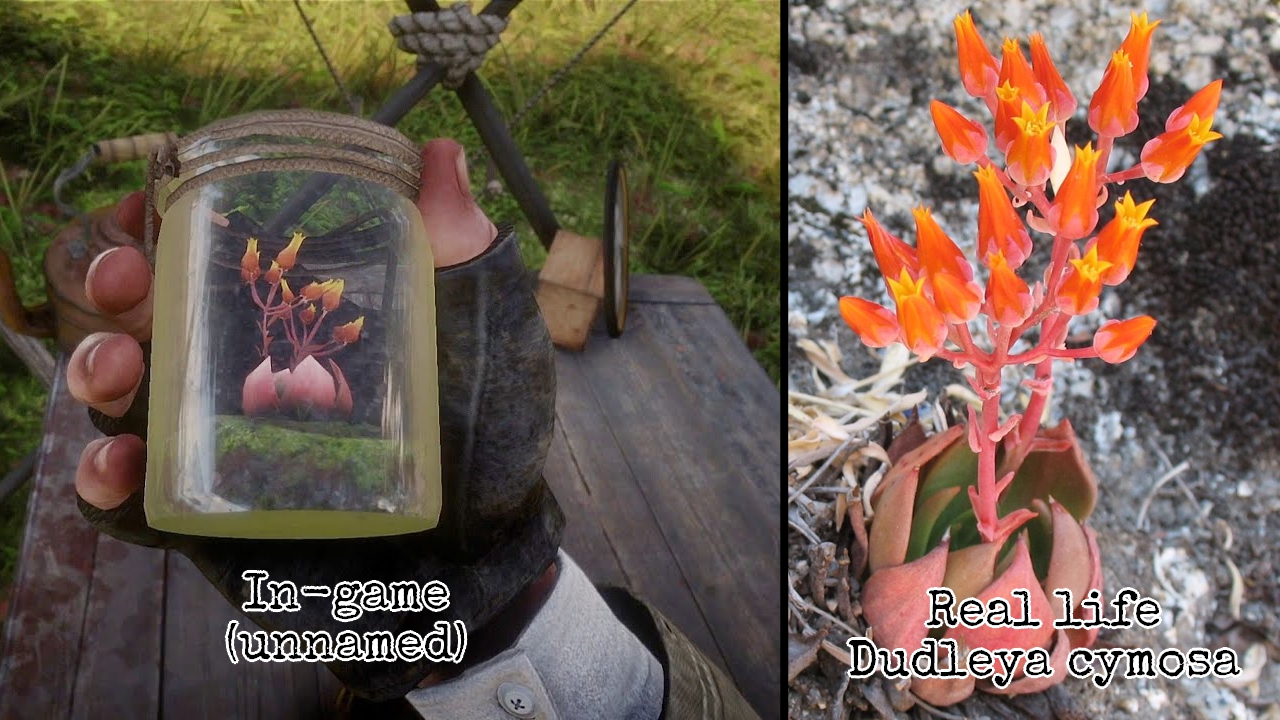
Here’s a plant I was surprised to see in game! It can be found on Arthur's bedside table in a little terrarium jar and nowhere else (that I know of) in game. Dudleya cymosa is a local native where I am, and Arthur actually references the fact that it’s a California endemic in conversation with Mary Beth over a game of dominoes.
The ingame rendering is gorgeous; its rosette of succulent leaves are curled slightly upward and pinkish, which its real life counterpart often does in more sun-soaked locations to retain moisture and protect itself from sun exposure. The Dudleya ingame is flowering, which happens around April-July depending on local microclimates. Given that rdr2 takes place from May to July, this is perfectly accurate! Its infloresence is a near-perfect recreation; two infloresences sprout from the sides of the rosette of leaves on a pinkish red stem bearing small cauline leaves of the same color. Its cup-shaped involucres are bright orange with yellow interiors, bearing five to six tightly fused petals which open into star shapes at the tips. Although the bracts of the game's plant don't cup the base of the petals as much as they do in real life, it's perfectly fine. In structure, coloration, and even in backstory, this plant is an absolute knockout.
My rating: 8/8 [AUTHOR'S NOTE: Add graphic visualizer for the rating wrt what points are where]
Lupinus polyphyllus
“Meadow lupine”
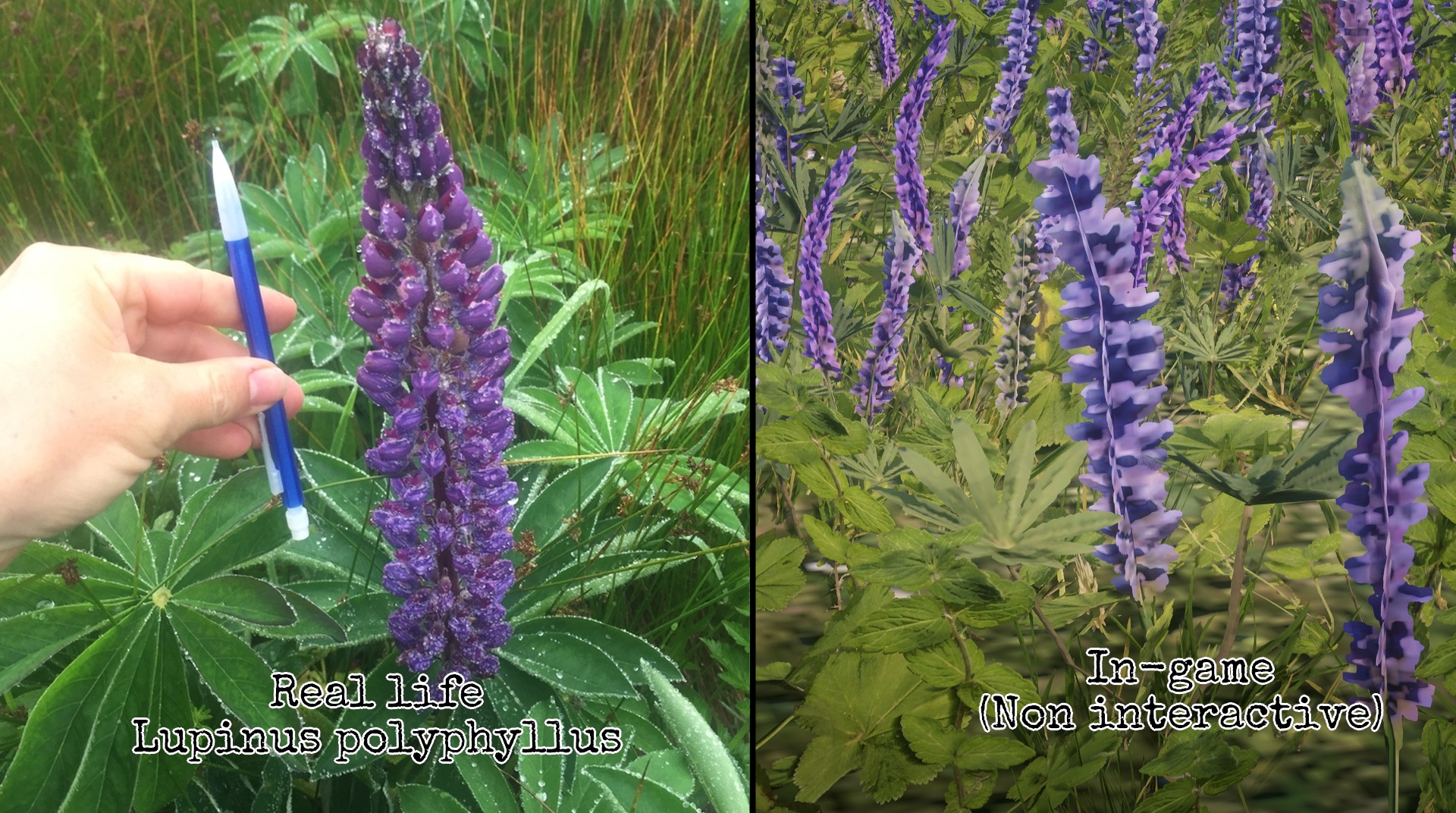
Who would I be if I didn’t begin with my favorite genus, (and my namesake!) Lupinus! I’m going to start by covering my ass, and saying that precise ID of lupines is difficult without close field examination (in some cases, even DNA sequencing!) That said, Lupinus polyphyllus or Lupinus latifolius are my best educated guesses for the plant pictured below. “Big Valley” is loosely based on the Sierra Nevadas and the Cascades, so both species are native and found commonly in these regions. The morphological characteristics of the ingame plant I looked at were large, palmate and (probably?) hairless leaves, with a long petiole and tall inflorescence. As you can probably see from the comparison image, getting a detailed screenshot is impossible due to the low resolution of the plant itself; its individual florets are almost completely lacking in definition, which makes looking for diagnostic features like banner spots, keels, and bracts impossible. So, based on growth habit and equivalent biome alone, this lupine is getting the Lupinus polyphyllus (possibly L. latifolius) label slapped on. Teresa Sholars, if you’re reading this, SOS.
My rating: 5/8 (they make such a pretty scene in Big Valley though)
Ruellia humilis
“Wild petunia”
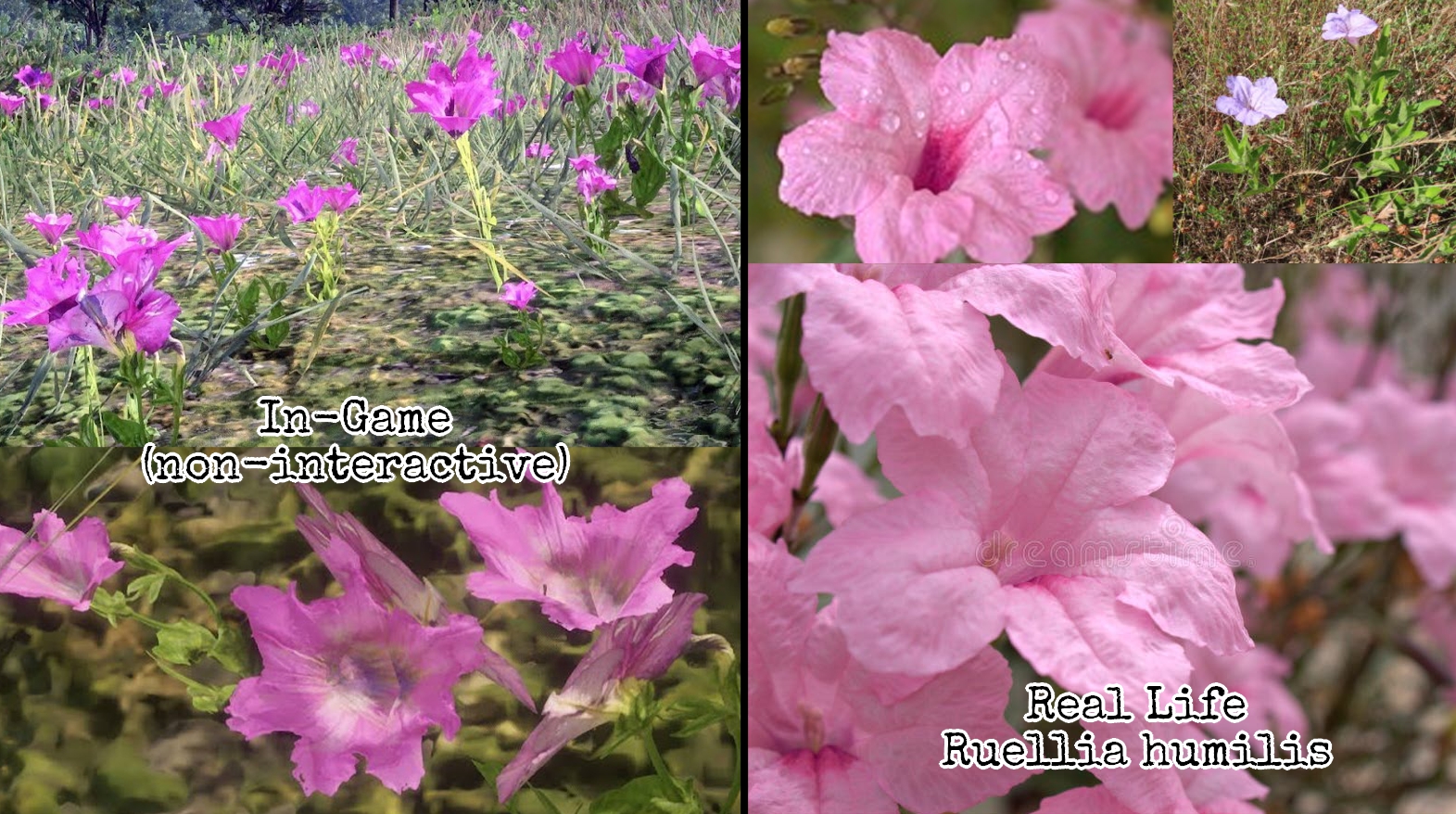
Ruellia humilis is an eastern US native that can be found in open meadows and sunny environments that get good moisture (so, most of the east coast and well into the south). The plant in game is the tricky sort which squishes when your camera gets too close, so narrowing down its species fell to its vague identifiable characteristics: wavy-margined petals, fused calyx, low growing habit, and simple variegated leaves. While several Petunia species would fit this classification, the genus is native to South America and these are growing wild in the game’s equivalent to western Appalachia, so Ruellia would’ve been a better choice given the time and place. I really love stumbling across meadows full of these Ruellias, they’re so peaceful looking and add so much of eastern charm to this game.
My rating: 7/8
Papaver somniferum
“Common poppy”
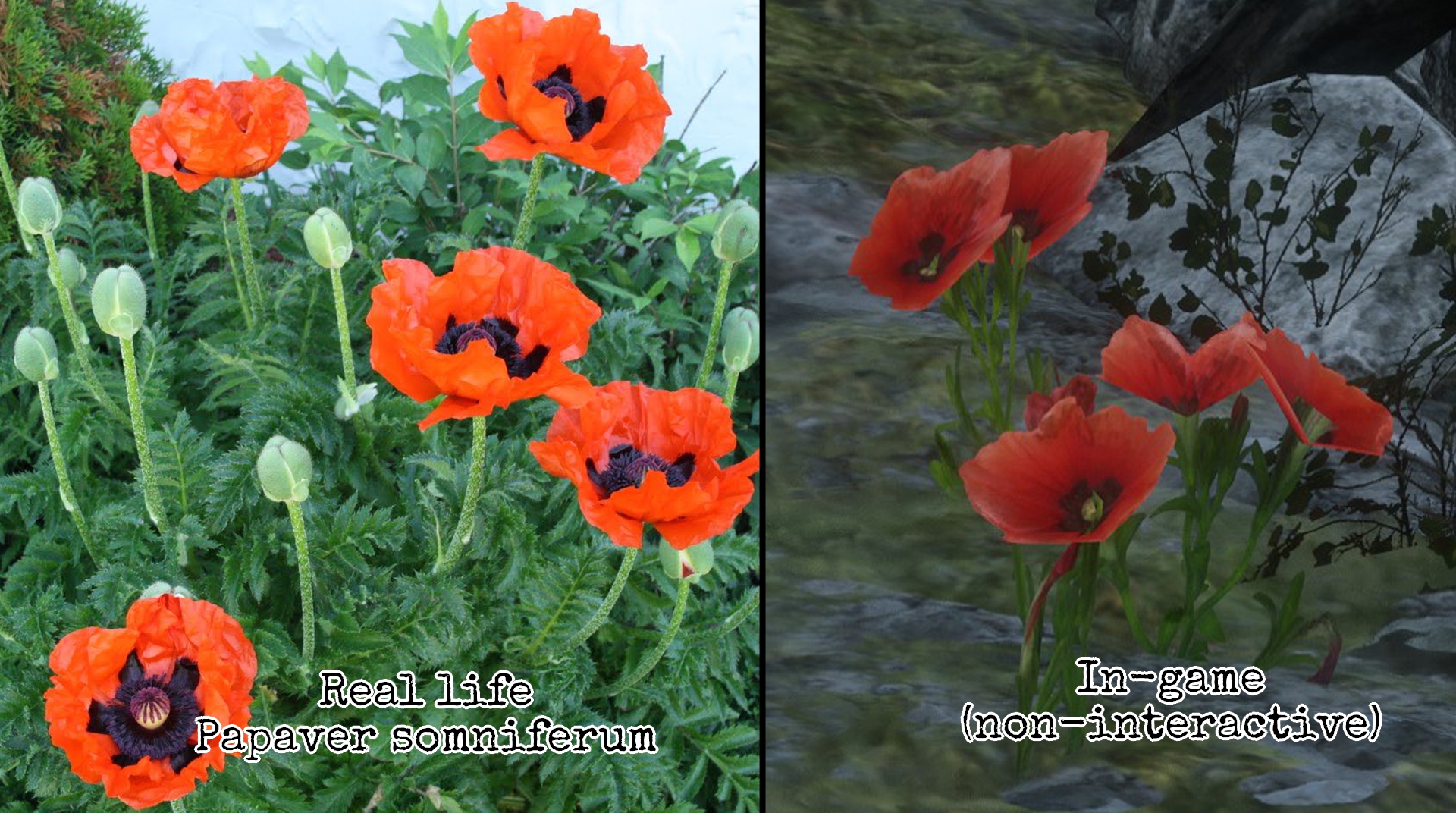
This is one of the easier to ID background asset plants in the game; everyone knows good ol’ common poppy. Their rendering ingame is actually pretty decent at first glance, with their prominent red silky petals and distinctive black marks near the throat. Their central pistil lacks definition however, and they suffer from Reused Asset Syndrome with their foliage. The leaves irl are a lovely blue-green (sometimes glaborous, sometimes hairy) lanceolate shaped, pinnately lobed with a toothy margin, none of which are featured here. Looking closely at their ingame rendering, there are dead flowers that have been recolored slightly from the Wild Petunias asset, which look nothing like the irl flowers after pollination; normally the petals will have dehisced, leaving a distinctive round ovary with a ribbed top.
Their placement and distribution ingame is also somewhat dubious; for being such an iconic part of the Grizzlies east’s landscape, it’s unlikely they’d inhabit the area in such large numbers at this time. Their native range is north Africa and Eurasia, and settlers in north america brought them for their use in opium and ornamental gardens; although they reseed easily, they don’t often travel too far outside cultivation (their fruits are poisonous to most animals here, thus lacking the usual avenues of seed distribution). As of 1899, their placement on the “east coast” of the game is sensible, but their sheer numbers up north are a little ridiculous. Although, if they were going for a Wizard of Oz callback... Maybe I gotta hand it to ‘em? Their symbolic placement in the spot where Arthur’s story ends (where I took my reference photo) is pretty good too.
My rating: 4/8
Strelitzia reginae
“Bird of paradise”
This is one that’s most commonly encountered around Saint Denis, but strangely enough can also be found in the Grizzlies East in a couple locations. Strelitzia reginae is a South African native plant that’s been widely cultivated in temperate climates for its gorgeous inflorescences and hardy foliage. They don’t tolerate cold well, so finding them in Saint Denis (a city lush with nonnative ornamental plants) is no surprise. Although the inner flowers are simplified, morphologically this plant is near spot-on. Its banner petals are upright and bright orange, its blue inner flowers are… Present. And its large bract (resembling a crane’s bill) is perfectly colored with its distinctive red and green. Its foliage is also perfect; large, upright, linearly simple leaves. Overall, these Stelitzia reginae are instantly recognizable and really lovely to see, even if there are a couple weirdly placed ones around the map.
My rating: 6/8
Yucca brevifolia
“Joshua tree”
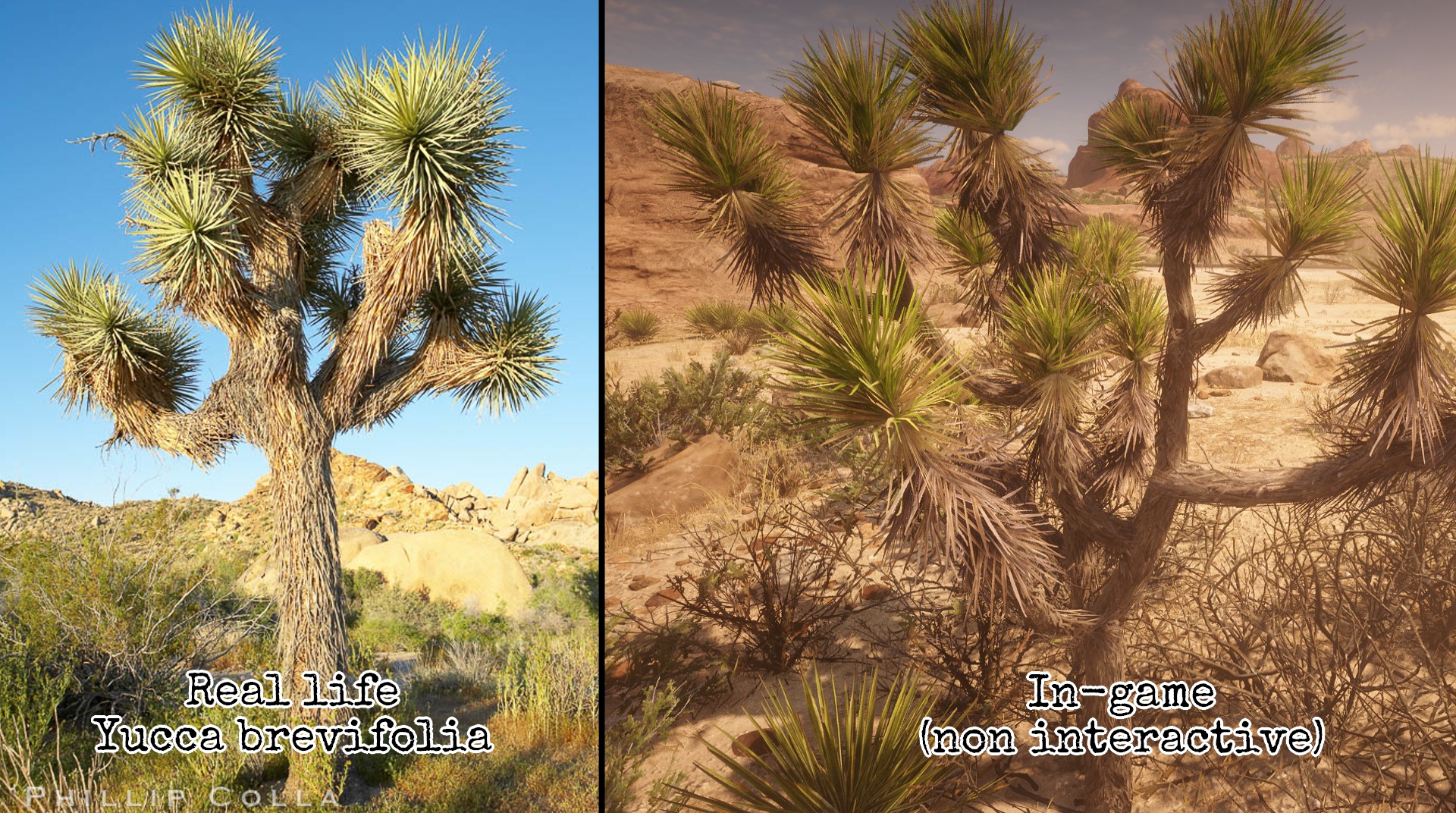
Yucca brevifolia is one of a few species of Yucca that take on an arboreal habit! Unlike more familiar tree species, however, its trunk and branches are fibrous and lack growth rings, making determining the ages of these plants difficult (estimates put their average lifespan around 200-500 years). In real life, these plants can be found exclusively in the Mojave, but their distribution ingame seems to be broadly around the lowlands of New Austin around Mercer Station. As for the game’s rendering, it’s absolutely spot on. The perfect rendering of the straight blade-like leaves around the tips of the branches, dead leaves providing a shingled form of sunscreen and moisture retention for the trunk, the gently sloping branches; there’s nothing at all I could criticize about this Yucca brevifolia rendering, except I wish we had one in bloom to look at. It adds so much atmosphere to the desert environment of New Austin as a gypsum soil indicator species.
My rating: 8/8
Cylindropuntia bigelovii
“Teddy Bear Cholla”
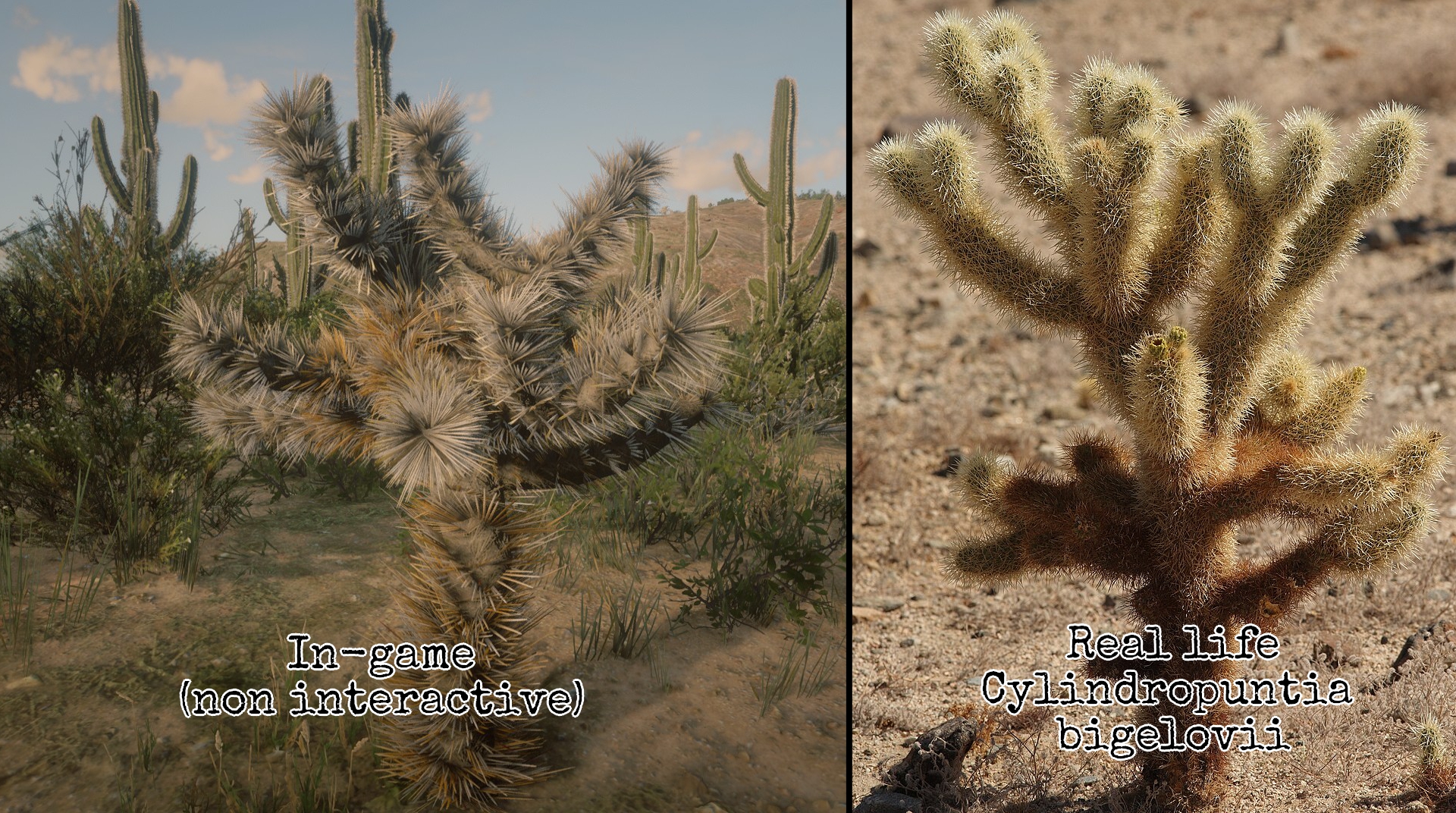
The teddy bear cholla cactus is a plant I hold a lot of fondness for. Look at it. It’s adorable. Cylindropuntia bigelovii is one species of about 30-35 in its genus, closely related to the Opuntia cactus I’m talking about next. If you live around the southwest, you’ve probably come across at least one of these! They’re well known for their wicked spines, which have a sheath that dislodges and embeds itself into skin, clothes, and fur. Ingame I enjoy running over these repeatedly on foot because they seem to have no effect on John, lol. IRL, these have a wide range and reproduce readily through cloning, forming large colonies (known colloquially as cholla gardens). Compared to its real life counterpart, the game devs did an excellent job of replicating the growth habit, dense spines, and distinct “trunk” of Cylindropuntia bigelovii. Again, I wish we’d gotten a flowering specimen to admire, but I’m more than satisfied with the cactus we have in game. 😊
My rating: 8/8
Opuntia lindheimeri (AKA Opuntia engelmannii var. lindheimeri)
“Texas prickly pear”
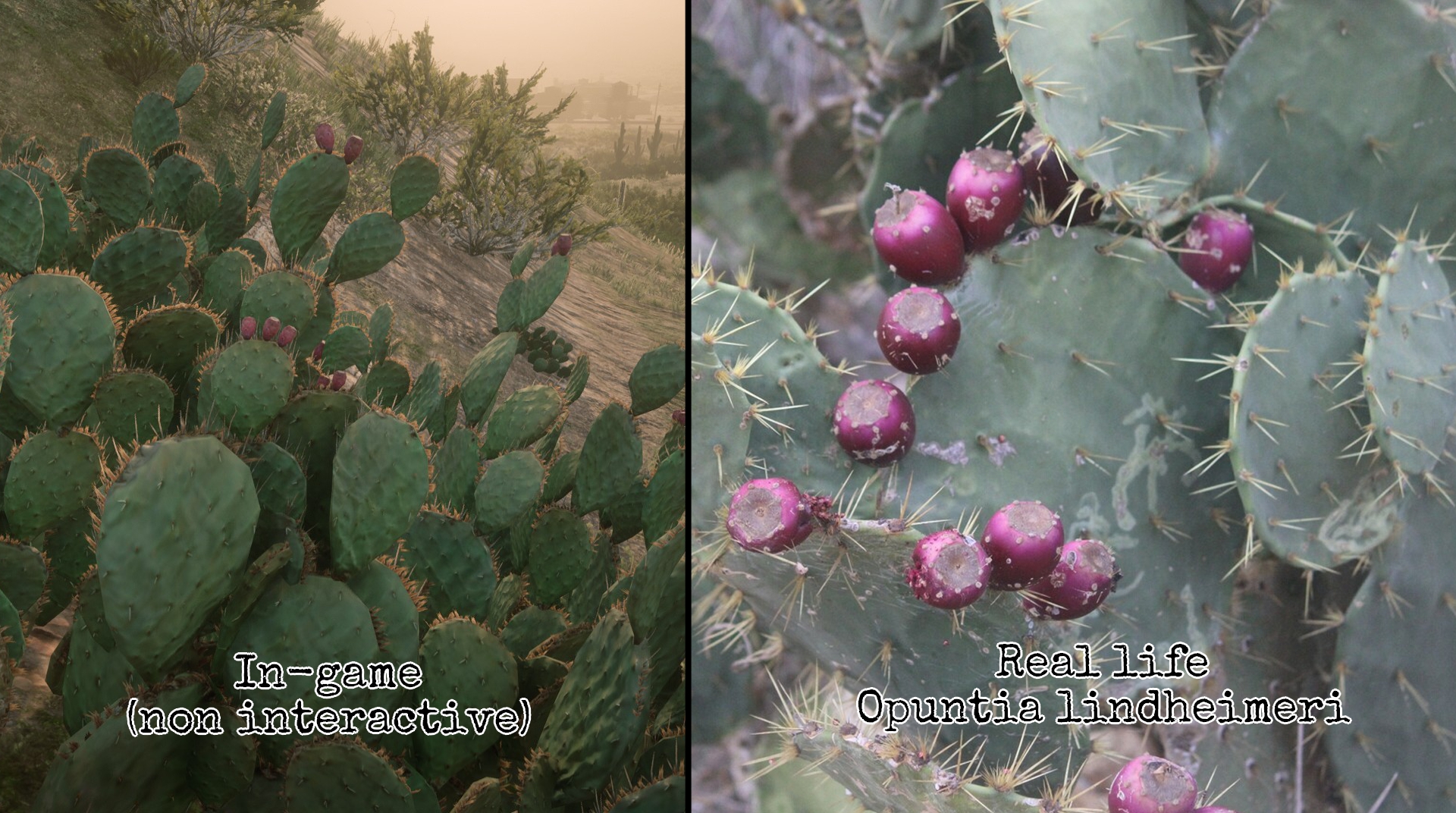
Oh boy don’t even get me started on the Opuntia taxonomic smackdown. As you can see, I used the name O. lindheimeri even though there’s debate over whether this is its own species or a subspecies of O. engelmannii; I chose the species route because I didn’t want to have to squeeze more text into the image, and because some of the craziest Opuntia specialists I know of swear by its status as a separate species.
Opuntia lindheimeri is my closest ID for this unnamed prickly pear that can be found all over the map; the ingame cactus appears to have two to five spines protruding from each areole and glochids (bristle-like hairs, ouch) along the tops of some leaf pads. Their areoles are more wide-spaced and spines more prominent than Opuntia basilaris or Opuntia ficus-indica, two species whose range overlaps with this one heavily. Unfortunately there are no flowers on the ingame cactus I can use to really narrow down the species with, but I’m reasonably sure in my ID here. The large groups you can find this cactus in are also a characteristic of O. lindheimeri, which forms clonal colonies by dropping leaf pads and growing roots from the leaf scar. As with all Opuntia species, the fruits and pads are edible, but this particular species isn’t commonly grown commercially. That recognition goes to O. ficus-indica, a hybrid species grown in arid climates around the world for food, drinks, and jams. The devs put a lot of love into the cactus renderings in this game, and it really shows with this one. The 3D leaf pads, the sound design when you (inevitably) ride your horse through a patch, the beautifully rendered spines and glochids; ough. It’s just beautiful.
My rating: 8/8. Another great cactus.
Opuntia polyacantha
“Plains prickly pear”
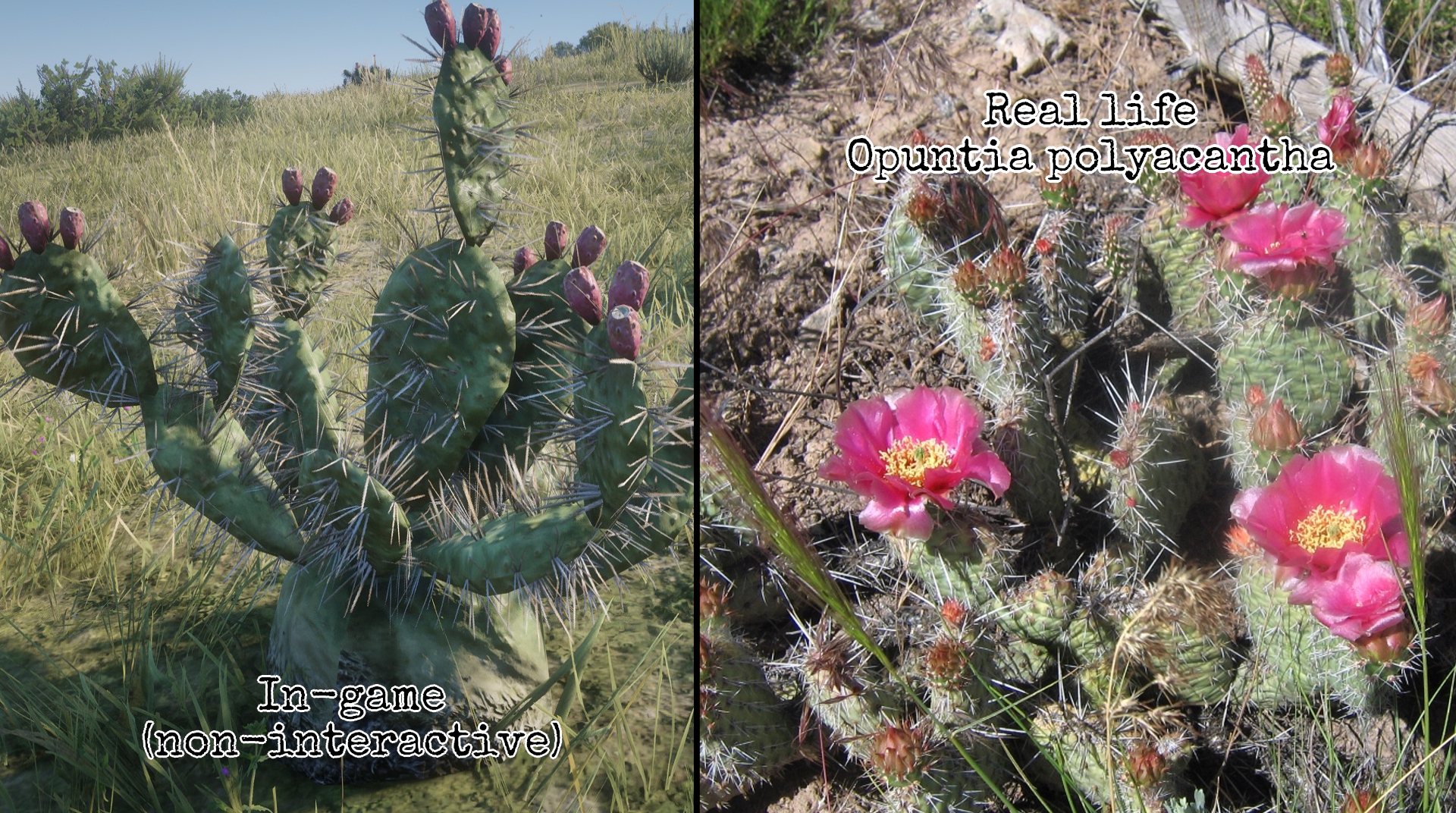
Opuntia polyacantha is another abundant Opuntia species. In contrast to O. lindheimeri this species is generally low growing, and comes in a wide array of phenotypic displays, making conclusive ID difficult. The cactus we see ingame has small, thick leaf pads, appears “lumpy” due to its pronounced areoles, and has prominent whiteish spines and spineless oval fruits. The one notable thing about this game’s cactus rendering, however, is a thick, trunk-like bulbous stem sprouting from the ground. The only real life Opuntia species that have a “trunk” are Opuntia leucotricha and O. ficus-indica (which this cactus definitely isn’t). For my own sanity, I’m going to ignore it and chalk it up to a render added for visual clarity when viewed from above. Habitat-wise, however, finding this cactus in the northern gypsum/limestone steppes of the Heartlands is completely expected: O. polyacantha is one of the most broad-ranging cacti in North America, being found as far north as Alberta and sticking to the great basin, the rocky mountains, and the western great plains (hooray for short grass prairies!). It’s a remarkably cold-tolerant cactus, and its inclusion in an accurate biome is something that really adds a lot of depth to this game.
My rating: 7/8
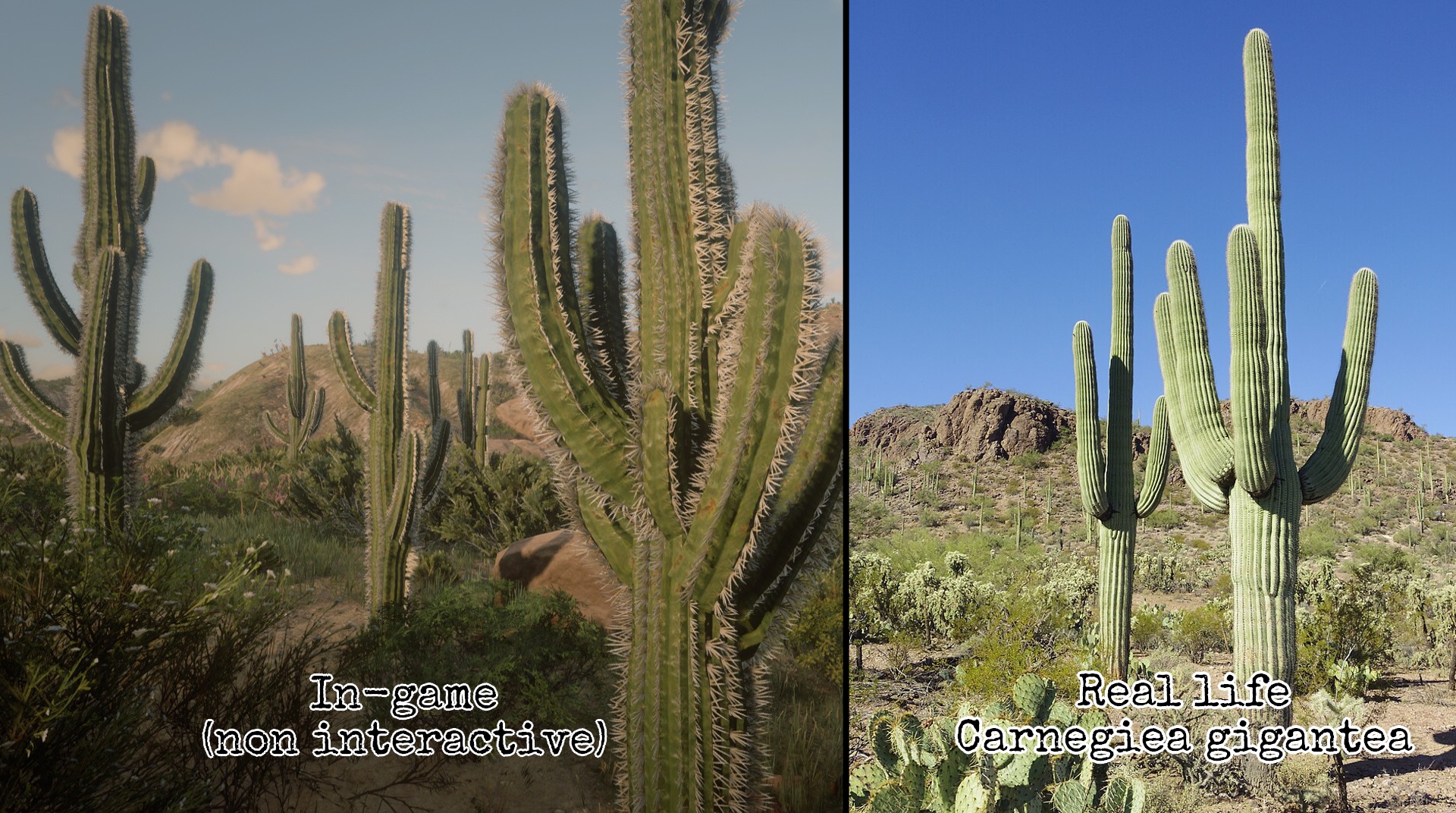
Carnigiea gigantea
“Saguaro cactus”
You know it, you love it! It’s the awe-inspiring giant that’s a keystone species for an entire ecosystem; Carnigiea gigantean provides food, shelter, tools, and building materials for animals all over the Sonora desert. Finding this plant so widespread ingame is actually pretty historically accurate too! Despite their extremely limited range in modern times, their historical range used to be a much broader, and their populations much denser. Saguaros are extremely sensitive to climate change and other modern human disturbances; they’re unable to germinate with too much frost and are sensitive to drought, unable to compete with invasive introduced grasses, and very limited by altitude. Unfortunately for how beloved and well-known they are, their populations in the last century have plummeted. Their game depiction is a beautiful glimpse into the past.
As for their morphology, the devs got them mostly right, they’re just a little small (and their spines are always shockingly white? I’m not sure if that’s a rendering thing with the lighting or what. It makes them look a little awkward.) I’d love if there was a patch update that gave them their true-to-life size. That “gigantea” species name isn’t just for show, y’know.
My rating: 8/8
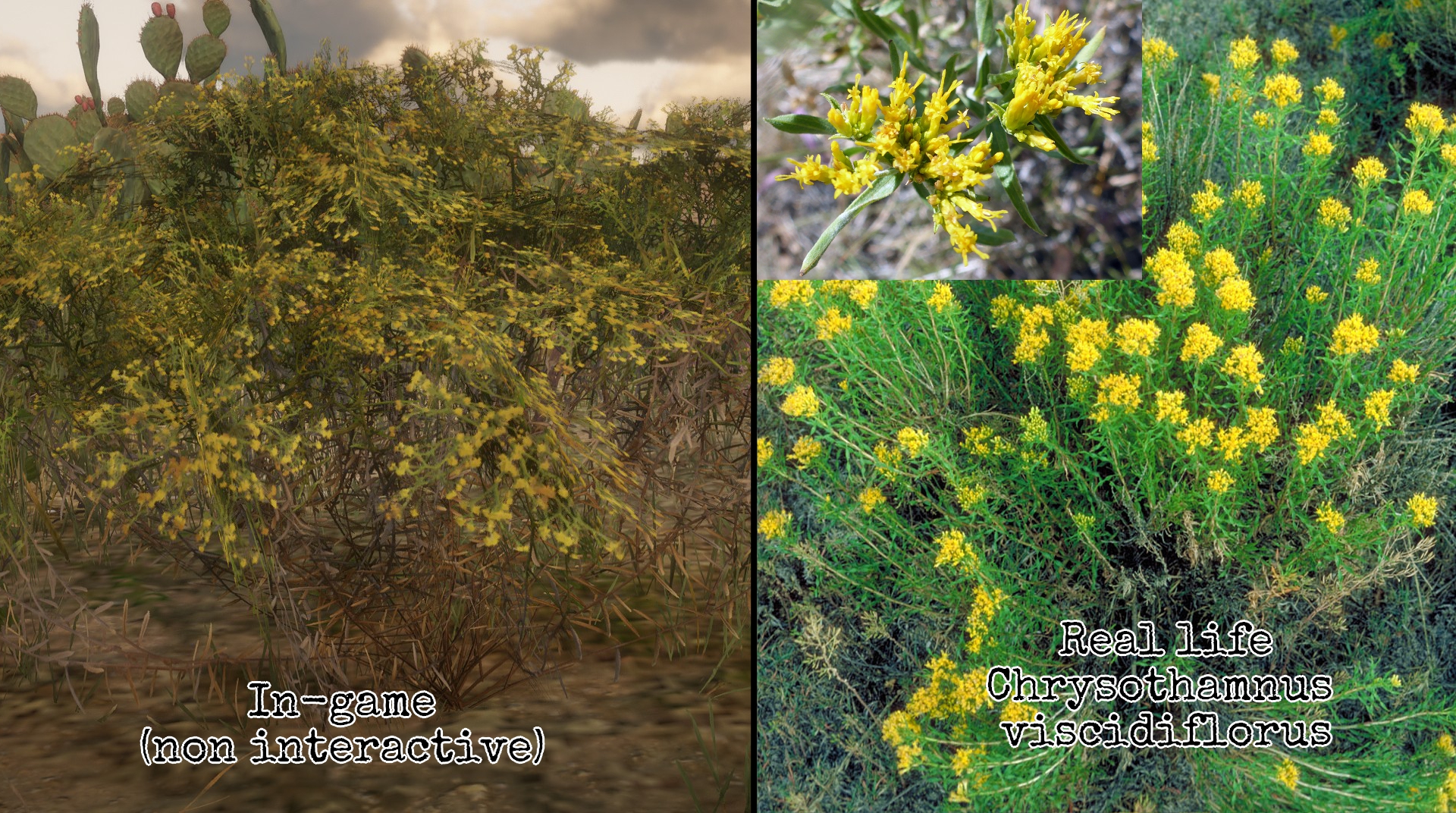
Chrysothamnus viscidiflorus
“Yellow rabbit brush”
What a lovely shrub! I chose a younger, more well-watered plant for my comparison photo just for visual clarity’s sake, so it doesn’t necessarily look as 1-to-1 as my other photos, growth habit wise. Regardless, Chrysothamnus is a genus of desert and chaparral dwellers everywhere west of the Rocky Mountains! If you ever have the chance to hang around the desert when it rains, these and the Larrea tridentada (and Artemisia) bushes are what make that unforgettable smell.
Ingame, this bush is rendered without much specific definition, but its tiny, almost indistinguishable flowers suggest its Artemisia tribe typical flower structure, with miniscule phyllaries around the involucre, which has long staminate florets extending from the greatly diminished ray florets. Its leaves are also greatly reduced, which serves to conserve moisture and reduce sun overexposure, characteristic of many woody plants in arid environments. Although overall this plant ingame leans more towards the "vague environment assets", it's just distinguishable enough to be worth a second look.
My rating: 6/8
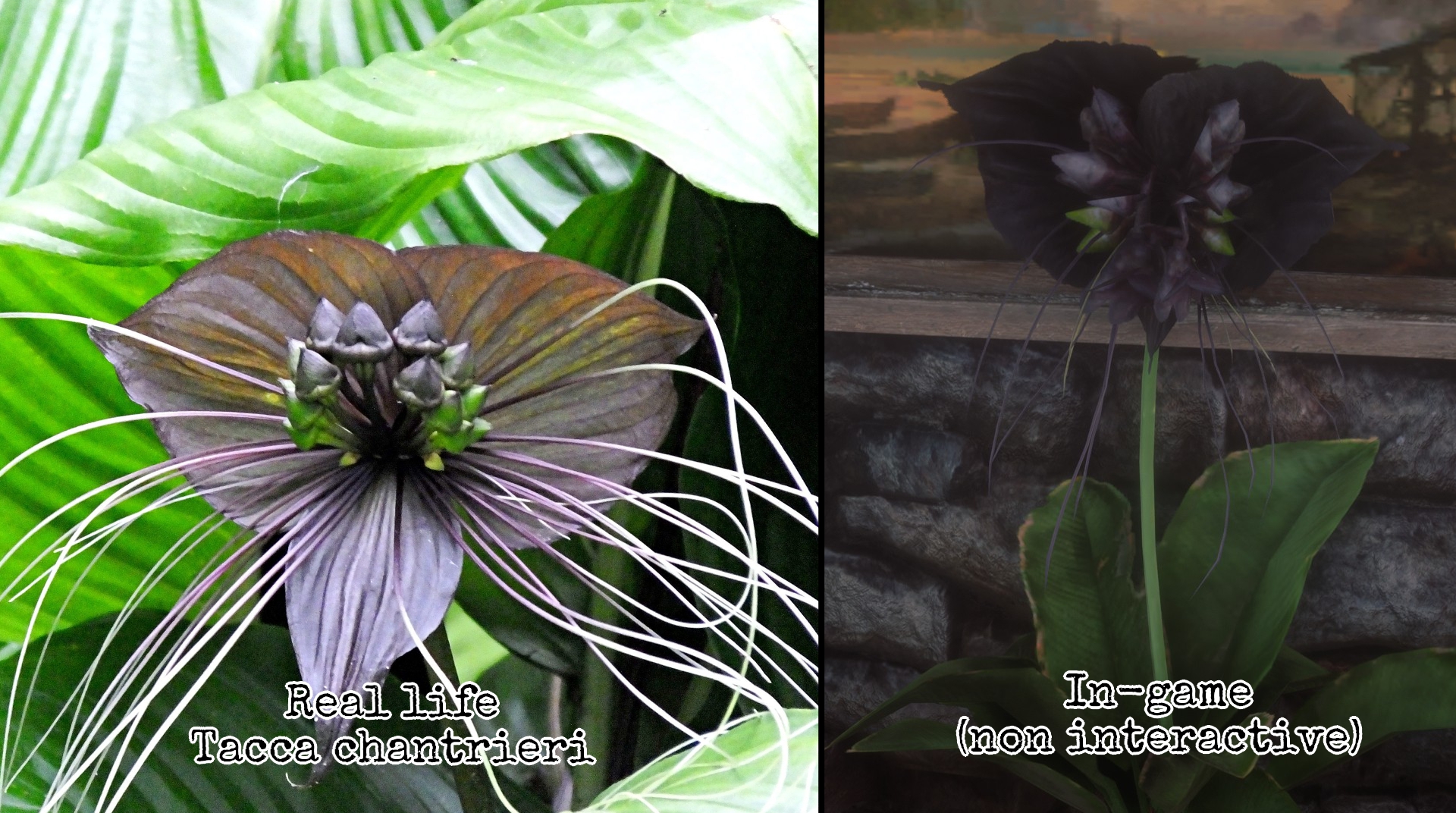
Tacca chantreiri
“Bat orchid”
This plant is one that sort of baffled me when I came across it in the Scratching Post homestead in New Austin. There’s a line by blind man Cassidy where he says “Find the black flower and you will be rewarded” but I’d already found it by the time he said that. There’s some loot in the dresser it sits on (spoiler alert lol). Whoever lived here must’ve been a traveler to southeast Asia, considering this plant’s native range. It’s a member of the sweet potato family, Dioscoreaceae, and thrives in tropical conditions not dissimilar to orchids (hence the common name). The ingame flower is surprisingly detailed for such a missable occurrence; its wide, slightly variegated bracts, several “capped” stamens, and long, whisker-like bracteoles are all true-to-life, and really capture everything that makes this plant so unique. The look of this flower also really adds to the mystery of this location, ‘cause I’ve seen folks online theorizing about it since the game came out. Maybe someday we’ll meet the traveler who took the time and effort to take care of this Tacca chanteiri so far from its homelands.
My rating: 8/8
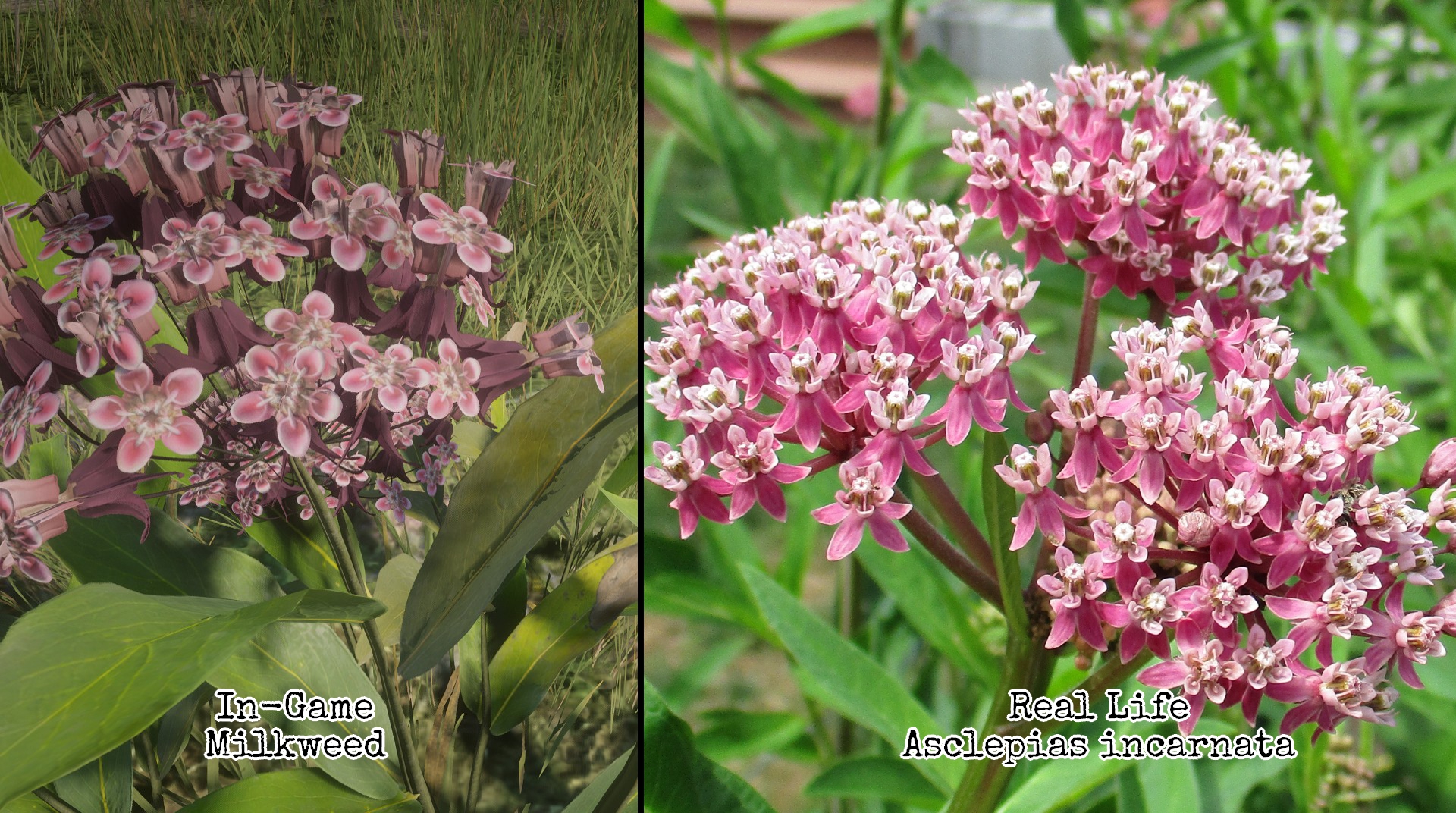
Asclepias incarnata
“Milkweed”
Asclepias incarnata is a popular plant for pollinator gardens (although here in the western US its invasive sibling S. curassavica is pushed on poor suckers looking to foster butterflies). It’s native to the east/southeast US and enjoys wet, swampy, and riparian environments, and its ingame counterpart can be found all over Lemoyne in similar habitats. As for its rendering, it’s got long, simple leaves with a prominent central vein, arranged alternately around the stem. Its growth habit of spreading by rhizome and forming little colonies is shown here accurately (although I didn’t get the best picture of it). Their flowers are the real show-stoppers here though; pink umbels with unmistakable five “petaled” coronas consisting of a hood, a protruding horn, central stigma with anthers fused to form an Asclepias diagnostic feature called a gynostegium, and the distinctive reflexed petals of the corolla. All of these are rendered in loving detail and I really can’t commend the developers enough for the beautiful work on this plant. What I would really love would be to see a fruit or an open seed pod here as well, but beggars can’t be choosers.
Although I don’t plan on covering any of the online plants you can discover with the collector role, it’s notable that Asclepias curassavica (“blood flower”) is harvestable with that role in game, and, notably, found in singleplayer mode on Arthur’s gravesite in the Grizzlies East.
My rating: 8/8
Asclepias curassavica
“Tropical milkweed”, “Blood flower”
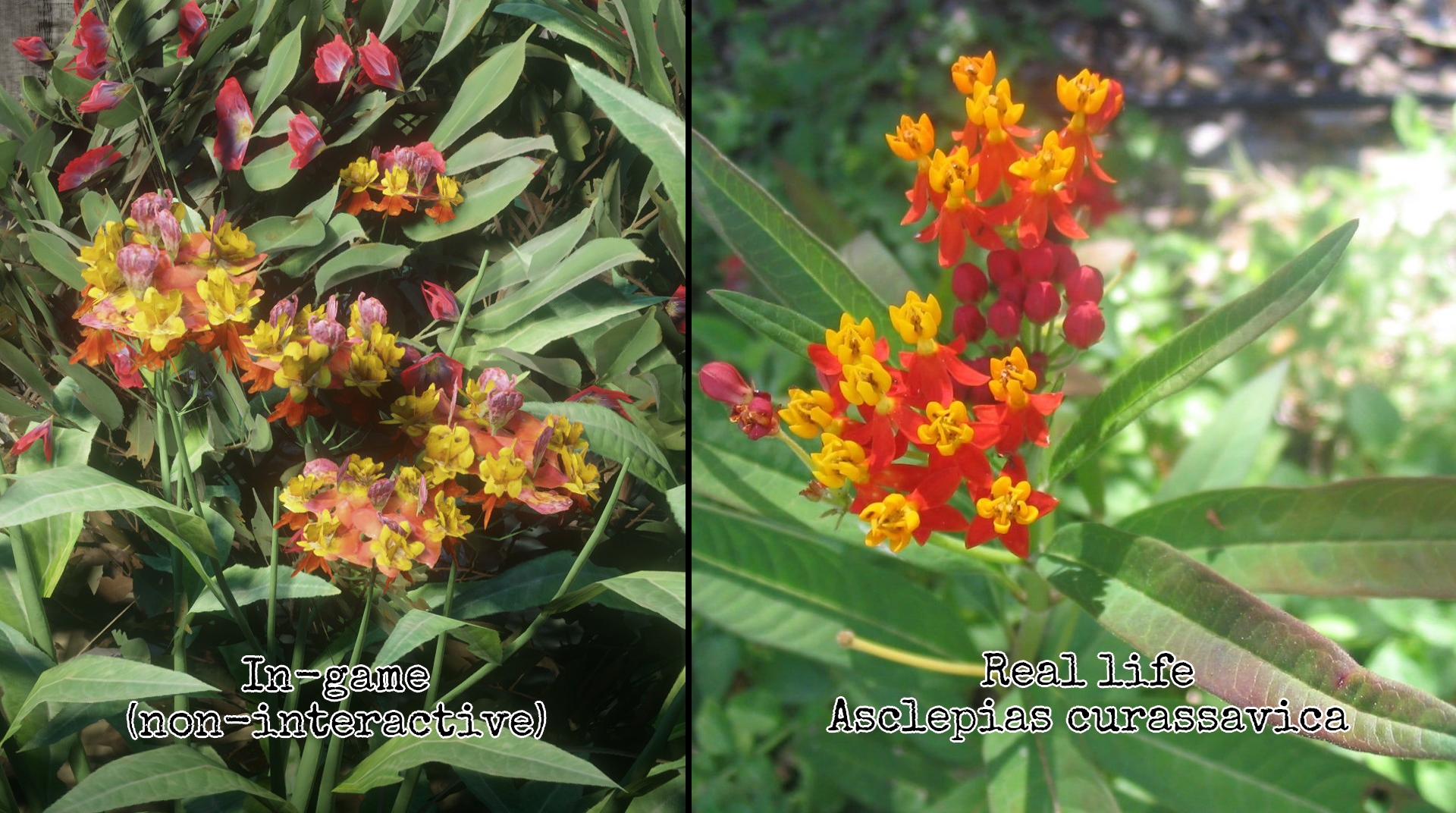
Okay, I know I said I wasn’t going to do the Red Dead Online plants, but this doesn’t count ‘cause you can find it as a background asset in story mode. Lo and behold, it’s one of the ones on Arthur’s grave! I wonder if Charles knew he was planting a nonnative invasive in this area. Either way, say hello to Asclepias curassavica! It’s a gorgeous milkweed that’s native to south and central america and the gulf coast. The ingame plant is rendered on three planes, where the reflexed petals characteristic of Asclepias are visible in a lovely red. With this rendering, the distinctive hoods, horns, and the gynostegium (fused anthers and pistil) is not visually apparent in the corolla, which sort of just looks like yellow “petals”. The leaves are also slightly broader than its real life counterpart, but retain their simple shape. Overall, this rendering is slightly muddier than its harvestable counterpart, Asclepias incarnata, but still a lovely addition to Arthur’s grave if you’ve completed the game with high honor.
(As an aside: I’ve seen several screenshots of this grave site, and each one has a slightly different arrangement of milkweed and camellia. Some are 50% Asclepias, some have 25% or none at all. Is this randomized, or dependent on factors ingame? Questions and more questions.)
My rating: 7/8
Muscari armeniacum
“Garden grape hyacinth”
I’m gonna be honest here. This ID is shaky.
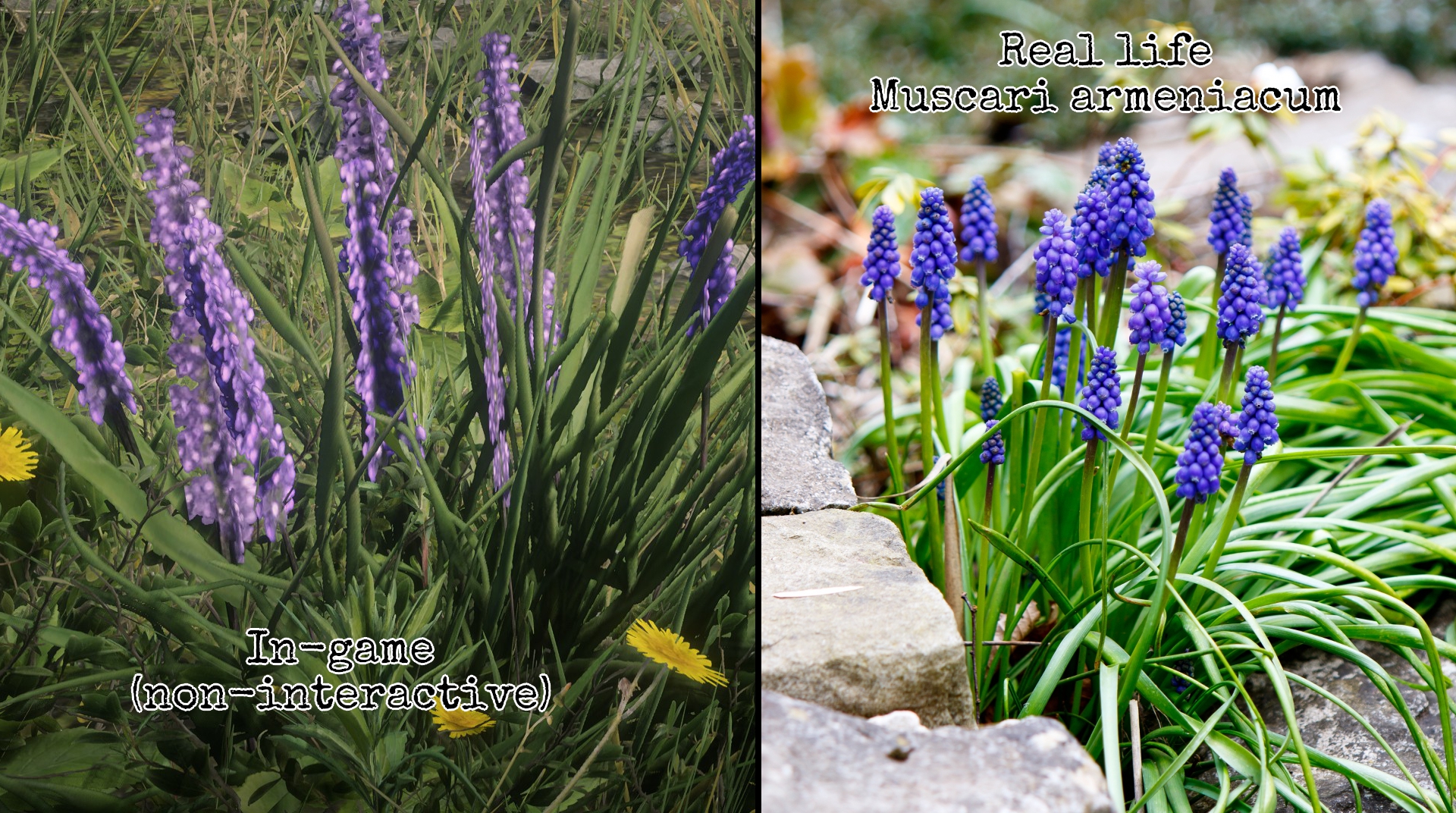
When I was looking at the ingame model of this plant, I thought it was a smaller Lupinus polyphyllus, but upon closer inspection, it’s got long, bladelike leaves rather than Lupinus’ characteristic palmate leaflets. Bladelike leaves and tall purple aggregate infloresences? What could it be besides a possible Muscari armeniacum? I just don’t know. If anyone’s got a better suggestion, I’d love to hear it.
With that out of the way, if this plant really IS supposed to be Muscari armeniacum, it’s got… A few inaccuracies. Most obviously with the size of the inflorescence; in real life, these plants have a rather short flowering body, maxing out at about 7cm. This ingame flower model leaves no room for deciphering individual florets either; in real life, Muscari armeniacum has little bell-shaped involucres that nod downward and create such a charming little conflagration of bells. It’s just lovely. As for this plant’s historical range, it’s native to much of Eurasia, and the earliest evidence of introduction by settlers in North America that I can find is early to mid 1800s. Is it possible that Arthur could’ve seen these in his travels? In the time of year the game’s set in, yes. Is it likely? Ehhh. I’ve made flimsier excuses in my plant analyses here before so let’s say yes.
My rating: 2/8. What is going on here
Camellia sasanqua
“Camellia”
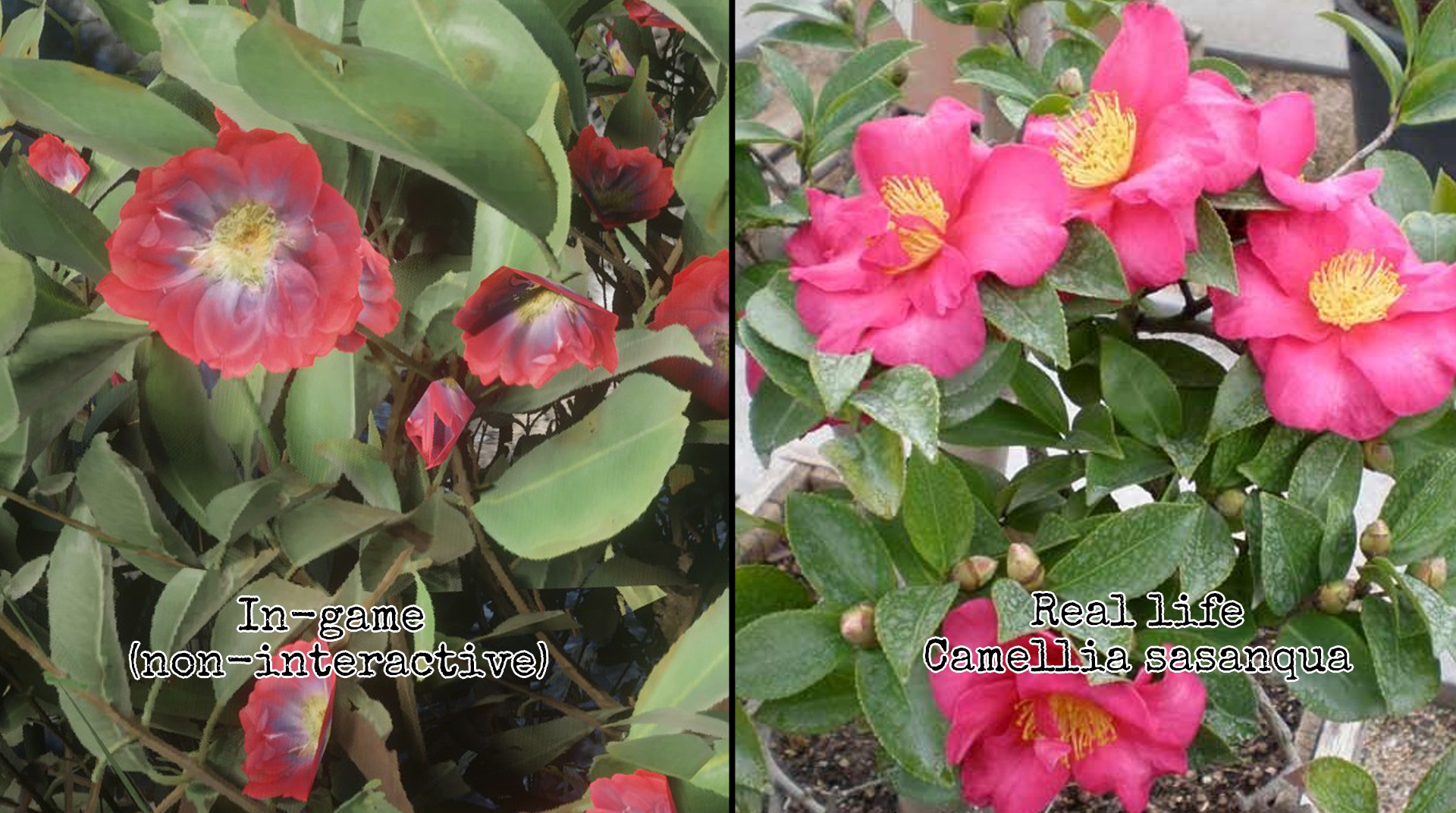
This is another flower found on Arthur’s (high honor) grave! You can also find it all over Saint Denis and outside a few homesteads across the map. Camellia has a long history of cultivation, documentation beginning in China as far back as around 4-5 thousand years ago. Given that the genus has been in cultivation for so long, there may be over 20,000 different varieties, hybrids, and subspecies; the sheer variety and history is only rivaled by the garden rose. Camellias are a hardy genus, withstanding hard frost, moderate drought, poor soil, and all levels of sun exposure. The ingame render does a lot to capture the essence of Camellia sasanqua, a genera that’s as widespread as it is beloved. It’s got evergreen, wide, simple leaves, and a corolla with numerous overlapping petals and a central collection of dozens of anthers. Although the flowers are somewhat poorly rendered on just one plane, they’re distinctive enough with the shrub growth habit to nail down to the Camellia genus, if not the sasanqua species. Camellia sasanqua’s introduction to North America likely began as an ornamental from europe, where C. japonica was popular since the 1700s. In the early 1800s, camellias travelled west with settlers, where it became the scourge of soulless corporate landscaping that they are today; its inclusion in various regions in rdr2 is entirely accurate.
My rating: 8/8. I wish the flowers were better defined.
Rhus typina
“Staghorn sumac”
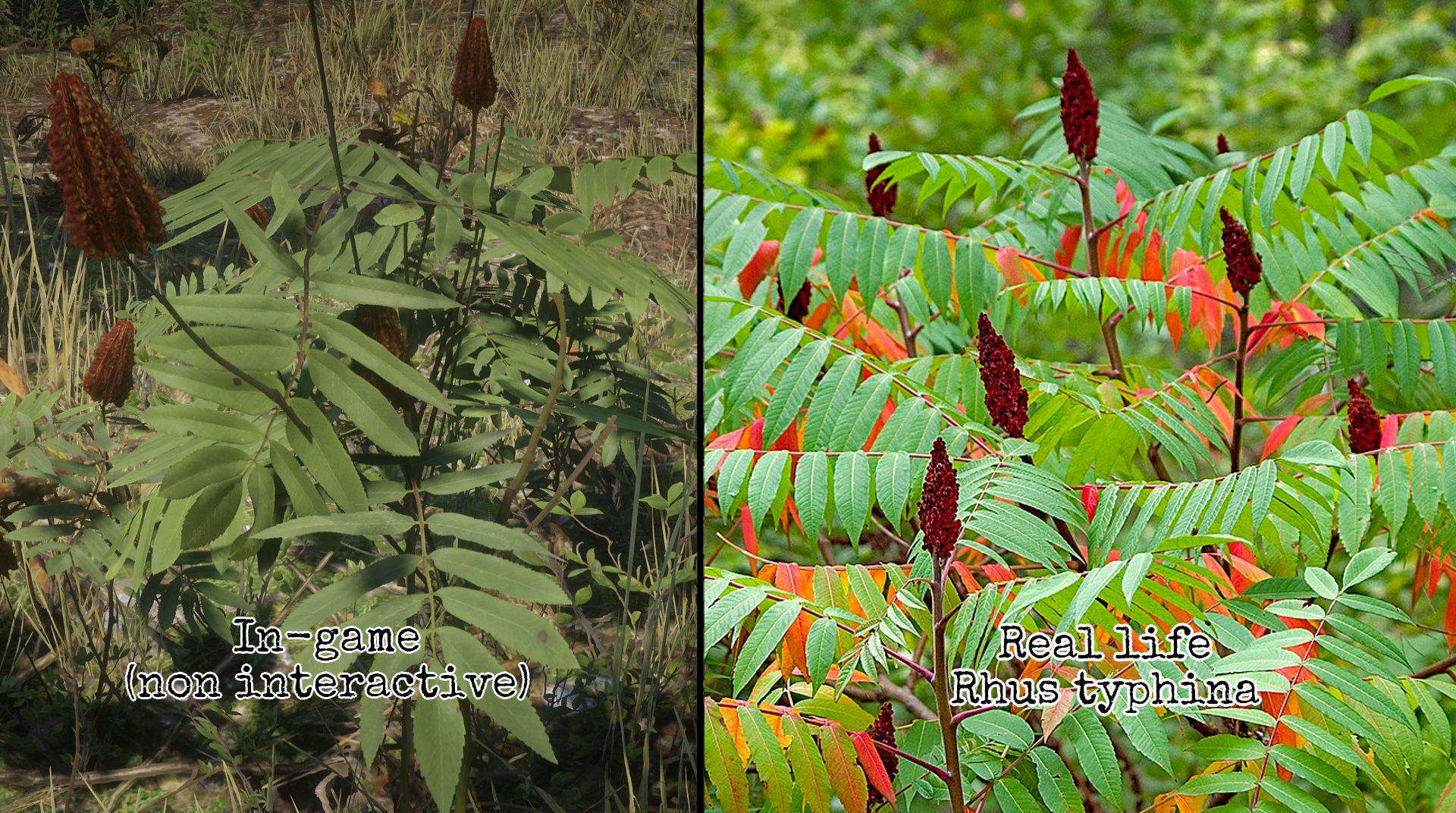
This is a plant I was only ever familiar with in “lemonade” form; it’s an east/northeast American native long harvested for all of its parts. Although the ingame Rhus typina can be found scattered through much of the map, it’s most commonly found around Valentine and the Cumberland forest, where the soil conditions appear faithful to its real-life preference for drier areas, but its geographic location should be from Emerald Ranch eastward. That’s just a minor nitpick though.
As for its morphology, the ingame plant is pretty accurate, if a little shrunken and simplified. Rhus typina’s characteristic red velvety texture along its petioles and stems appears to be implied through a slight rust coloring. Its opposite pinnately compound leaves are simple shaped just like its real-life counterpart, and its defining characteristic is its infruitesence, a spike shaped aggregate made up of multiple drupes. In their native range, these fruits ripen from late summer to autumn, and remain on the plant through winter. They’re very popular with birds, or so I’ve heard. The berries are used for human use in a sweet Sumac lemonade and sumac tea, and its leaves and bark have a very high tannin content that makes them valuable as a natural dye/color fixer.
My rating: 7/8
Hosta plantaginea ‘Sagae’
“‘Sagae’ Hosta”
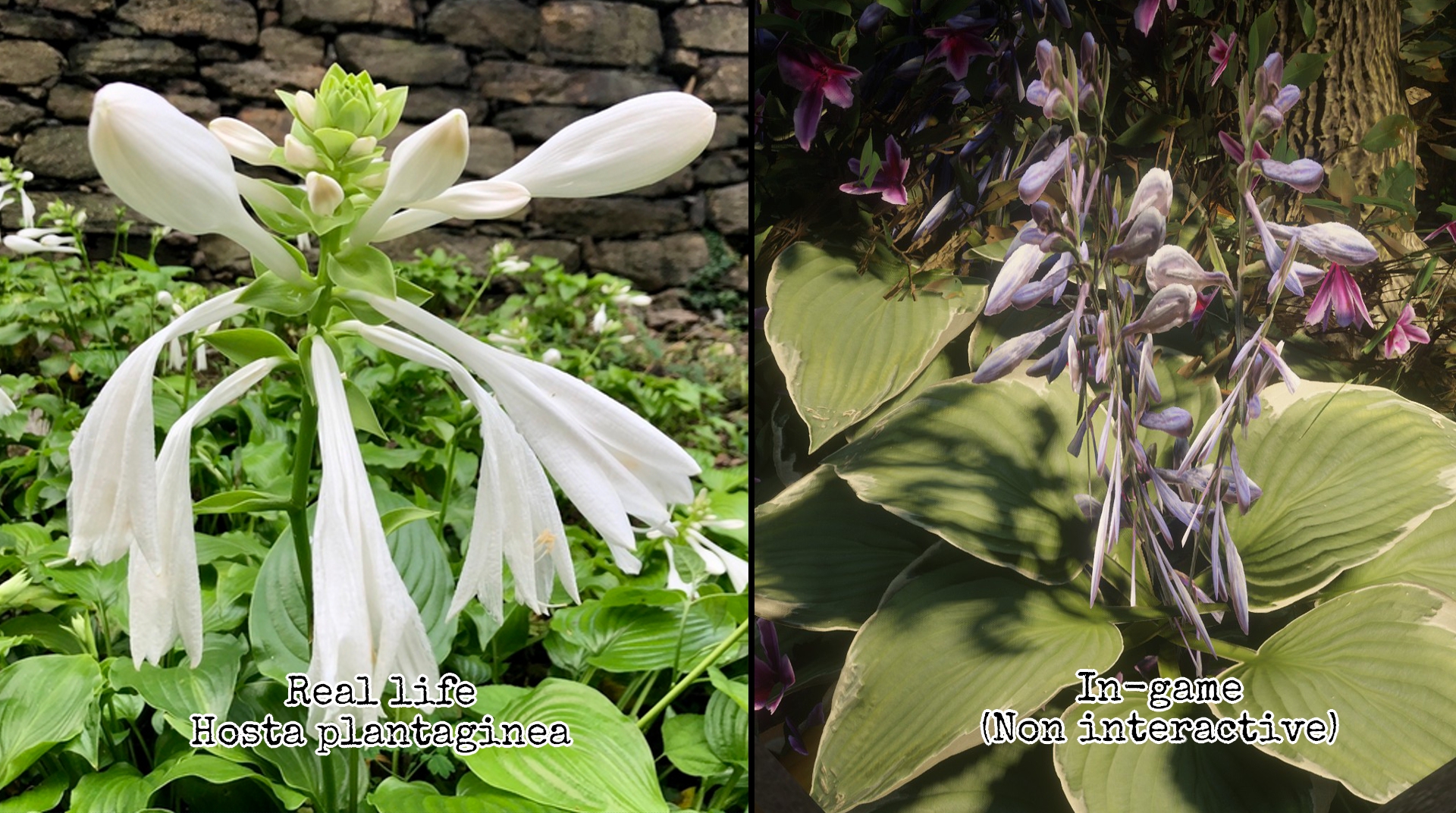
There are so many introduced species in Saint Denis. I could probably spend a lifetime in this city and still find something new behind every alleyway. Well, this one you can find growing in parks around the city, as well as old lady’s gardens all over the real-life US of A. Hostas have been a horticultural attraction since their introduction from Asia in the mid to late 1800s, grown as much for their flowers as for their foliage. The game’s Hosta, in particular, seems to be a semi-modern cultivar known as ‘Sagae’, grown for its gold variegated leaves and showy white/lavender flowers (captured ingame quite beautifully).
Saint Denis being a large port city, it comes as no surprise to be seeing Hostas in gardens at this time in history. My screenshot isn’t very good but the developers really did an excellent job capturing the growth morphology of these plants, with their numerous petalled flowers blooming from an “inflated” bud, extending from cauline bracts. I’ve never grown these personally but they come highly recommended for shade gardens.
My rating: 8/8. Sorry I didn’t include the Sagae cultivar image to compare to. You’ll have to take my word that it’s a dead-on likeness.
Aphanostephus skirrhobasis
“Arkansas Lazy Daisy”
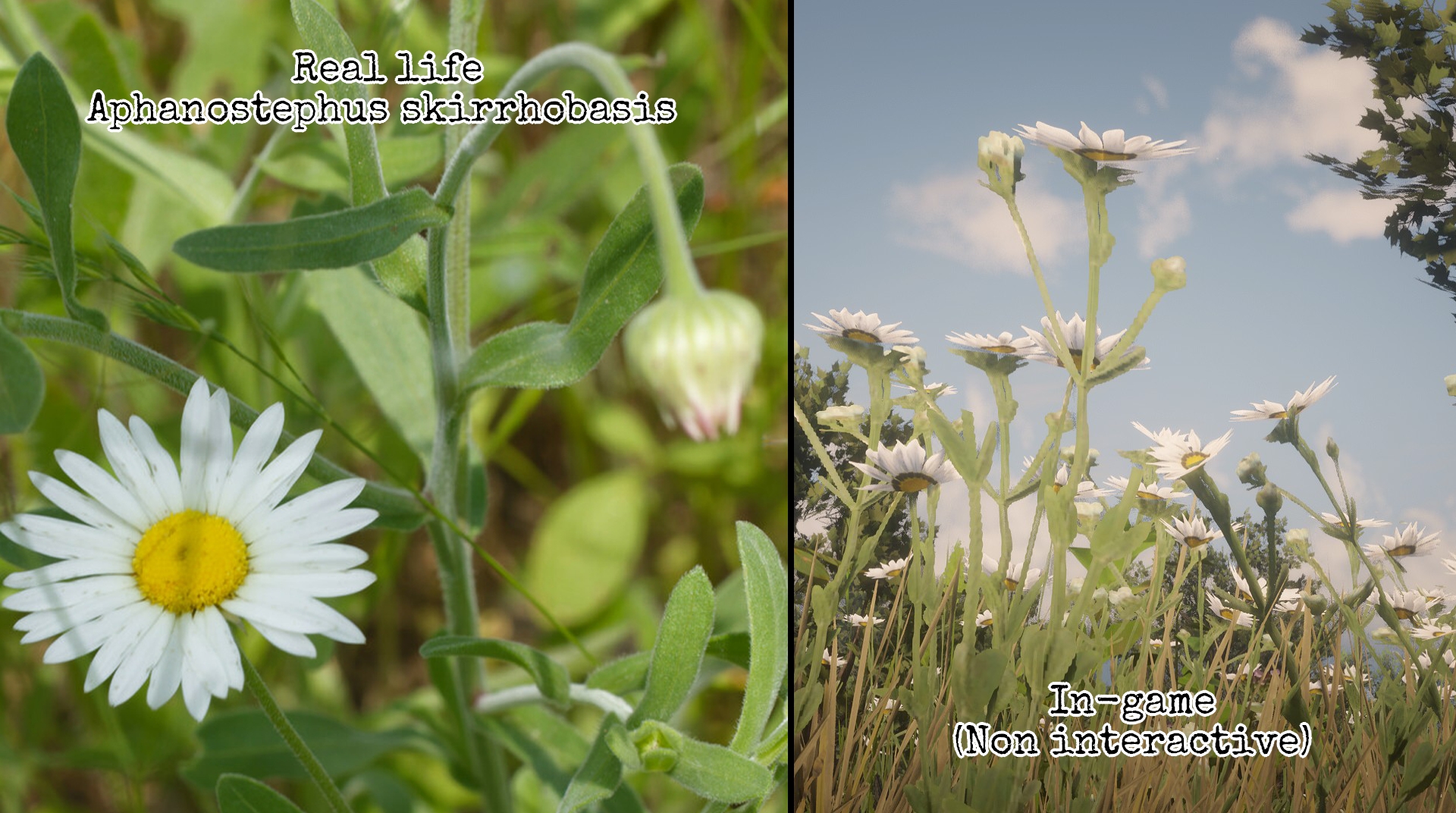
This is another plant ID that I’m kinda just guessing at, so like. Holler if you’ve got a better one cause I don’t know SHIT about the Asteroideae subfamily.
The ingame plant I looked at was widespread through the Heartlands and Lemoyne, notably one of the meadow flowers growing on Kieran’s grave (rip).
It’s got a branching inflorescence with simple slightly elongated cauline leaves, with flower heads branching from interpetilary nodes. The flowers are the daisy family’s characteristic composite flowerheads, with wide-ish ray florettes not bearing visible notches at the ends. Its basal leaves are absent ingame, which I’ll chalk up to being a render shortcut, but compared to its real-life counterpart, it’s not a huge deviation. The real Aphanostephus skirrhobasis doesn’t have a basal rosette so much as a basal clump of slightly bigger leaves, largely dependent on how arid its growing conditions are.
The only major deviation I can see between the two plants, which lends some dubiousness to my ID, is that the visible buds aren’t drooped downward (hence the “lazy daisy” common name). It’s also impossible to tell what the bract structure of this plant looks like (hence my slightly awkward screenshot angle, I was trying to see the damn bracts). Since bracts are a key diagnostic feature in most plants in the Asteraceae family, it’s really making my life difficult here.
My rating: 7/8 for the dubious details.
Origanum vulgare
“Common oregano”
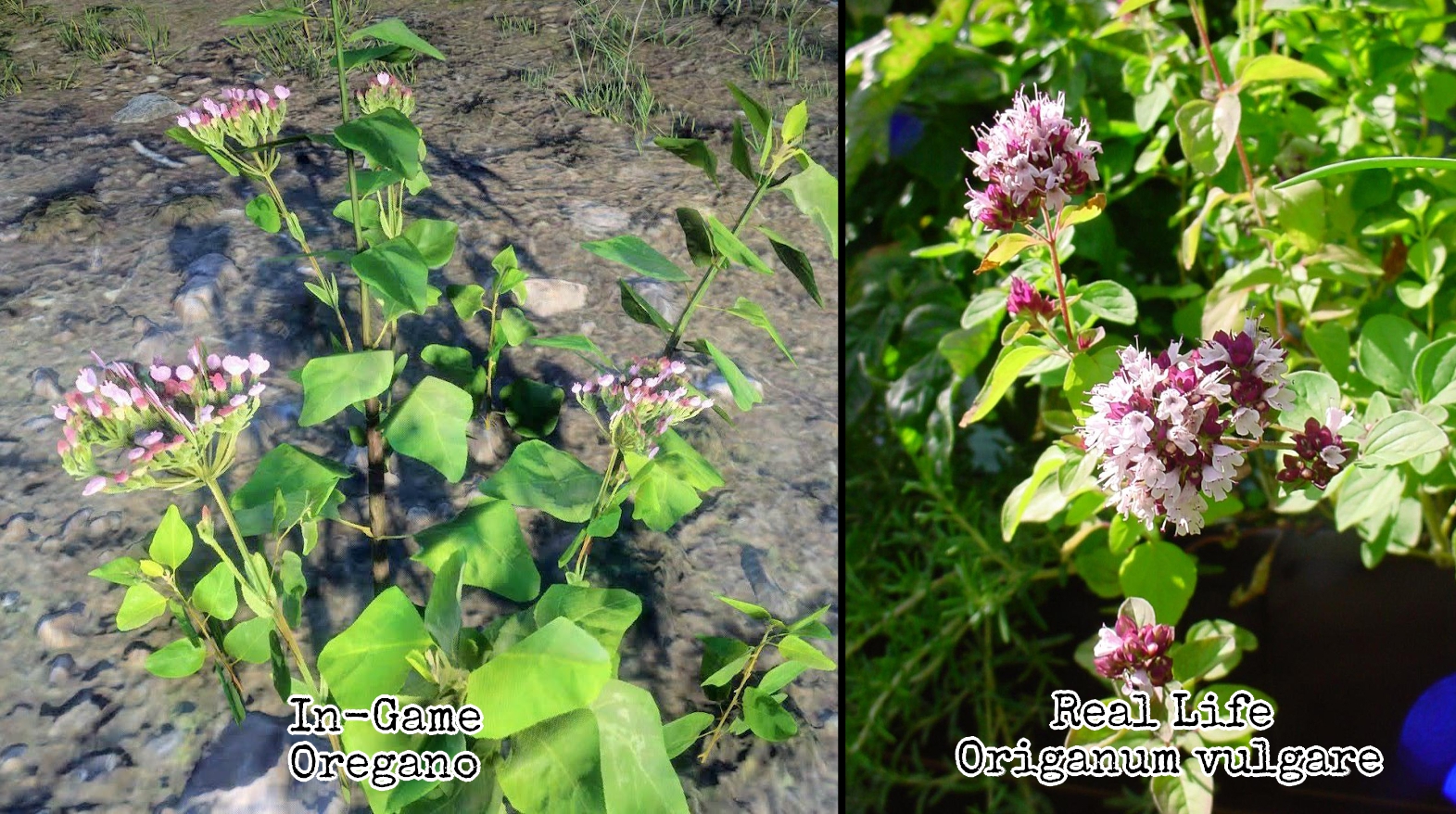
Overall pretty great depiction of common oregano. It’s an introduced species in North America, native to Eurasia and the middle east.
The leaves are appropriately simple, spaced alternately along the stem, but lack the more defined venation often present in real life. Compliments on the flowers, too; they’re accurately depicted as umbels with darker pink bracts below the light pink flowers, with a protruding stigma and styles. While somewhat lacking in definition, if you look closely you can see the three lobes on each cup-shaped flower, characteristic of this plant’s family Lamiaceae. I wasn’t able to get a good enough look in-game but it doesn’t look like this rendering shows a square stem, another characteristic of the Lamiales.
What’s interesting about this plant is its relative obscurity at this time in this part of the country; though lacking a specific date of arrival, it was introduced with settlers from europe but stayed localized in cultivation around the east coast, where italian food was popular with immigrants. It wasn’t cultivated widely until WWII soldiers returning from italy brought demand for italian food to the forefront of american cuisine. But that’s a whole other story. The fact that Arthur can collect these all over the map at this point in history is a bit anachronistic unfortunately.
My rating: 6/8
Daucus carota
“Wild Carrot” or “Queen Anne’s Lace”
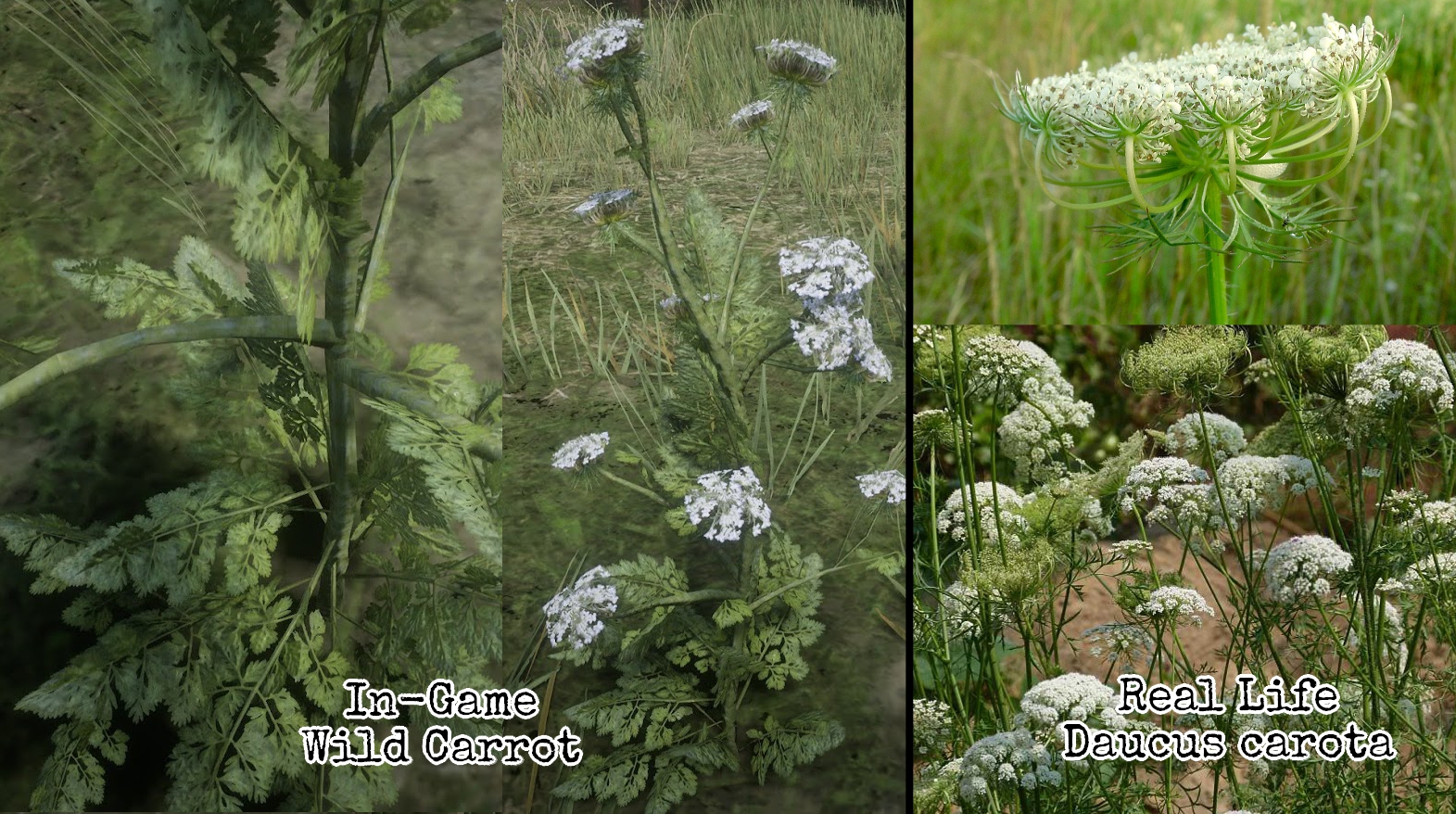
Another really nice rendering on the dev team’s part. Wild carrots are native all over Eurasia and Africa, introduced and naturalized in North America. It’s a really hardy plant that thrives in disturbed areas, especially around mediterranean climates. You’ve probably seen them along roadsides a few times.
The leaflets are rendered with a characteristic tripinnately compound fern-like shape with long petiole originating from the base of the plant. The pedicels are tall but lack the distinctive prickly hairs seen on the real plants (a key diagnostic feature, but understandable why they couldn't render them). The flowers are small, white, and ill-defined (again, can’t blame them, they’re tiny irl too) and arranged in terminal umbels, characteristic of the Apiaceae family. What really stands out about these in-game is the care taken to render the bracts on the underside of the umbels. They’re rendered in 3d and it really gives the flowers a big accuracy boost. The only thing about this rendering is the growth habit; the umbels are a little small for Daucus carota, but this is just a minor peeve.
This is another plant that we don’t have a specific time of arrival for, but given this its hardy nature and tumbleweed-like method of seed dispersal, it’s entirely likely that it WAS all over the country around 1899, cultivated or not.
My rating: 8/8
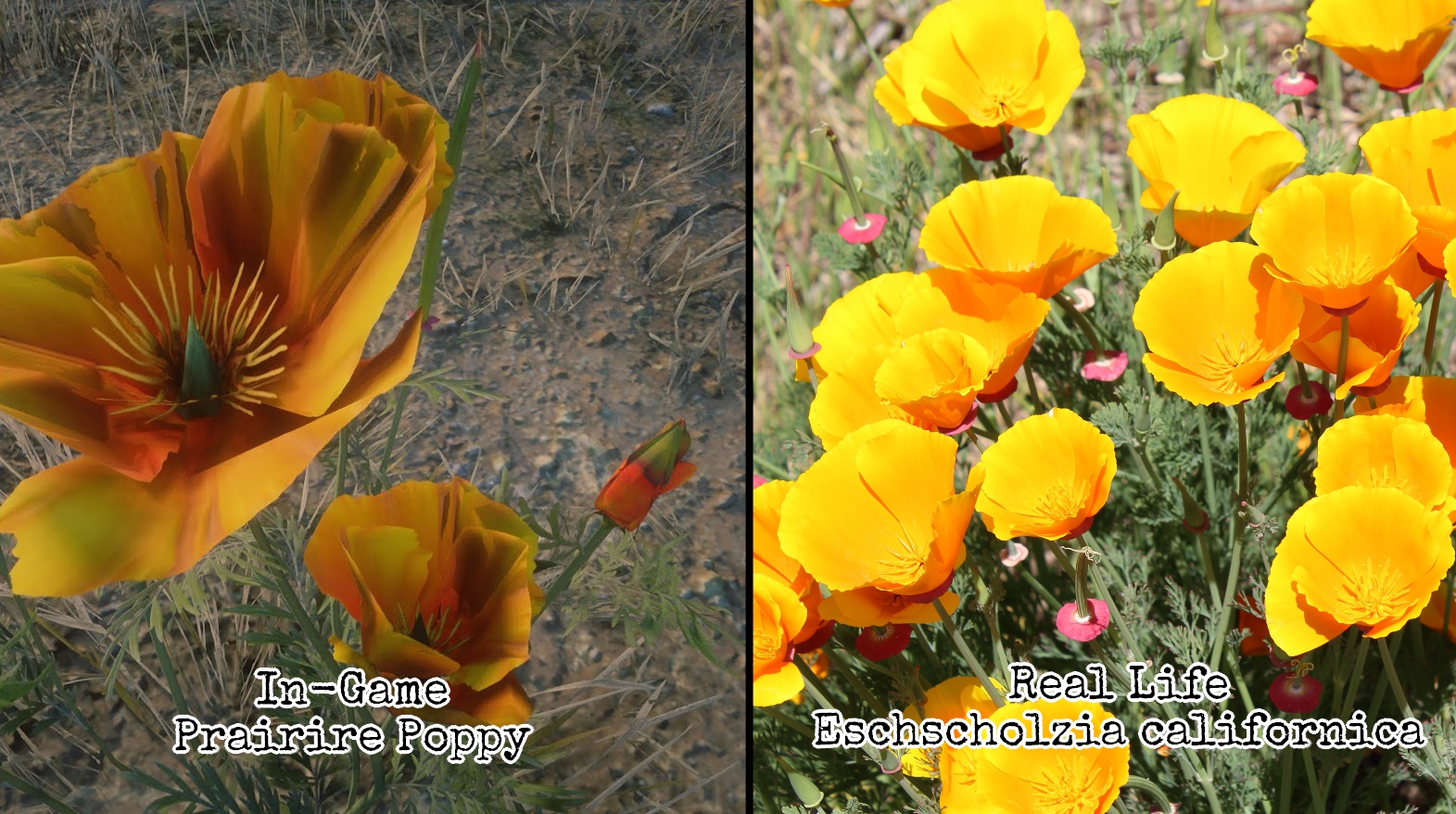
Eschscholzia californica
“California poppy”
A western North America native! Also one of my favorite plants ever.
I have a love-hate relationship with this rendering. On the one hand, great care was taken to depict the styles and the pistil, as well as the different development stages; you can see the sepal “cap” dehiscing from a new flower, a freshly opened one, a mature pollinated flower with the lengthening pistil, and a maturing ovary. They’ve even rendered the exaggerated reddish receptacle that’s a diagnostic feature of Eschscholzia californica! The petals look a little odd but they’re accurate enough, four (weirdly wrinkly) overlapping petals forming a cup shape. Unfortunately the devs kinda dropped the ball with the foliage. IRL they’re finely divided leaflets with a long branching petiole terminating in glaucus blue-green lobes. They form a rosette at the base, with a single flower per stem that originates from the base of the plant. In-game, they have a strange bipinnate leaflet that just sort of sticks out willy-nilly, no basal rosette, short ass petiole. I really don’t know what’s going on with the foliage in this in-game depiction.
They’re confined to West Elizabeth and New Austin, which mimics their real world habits of remaining mostly in the more arid and mediterranean climates of western North America.
My rating: 6/8. The flower growth details save this from being a 4/8
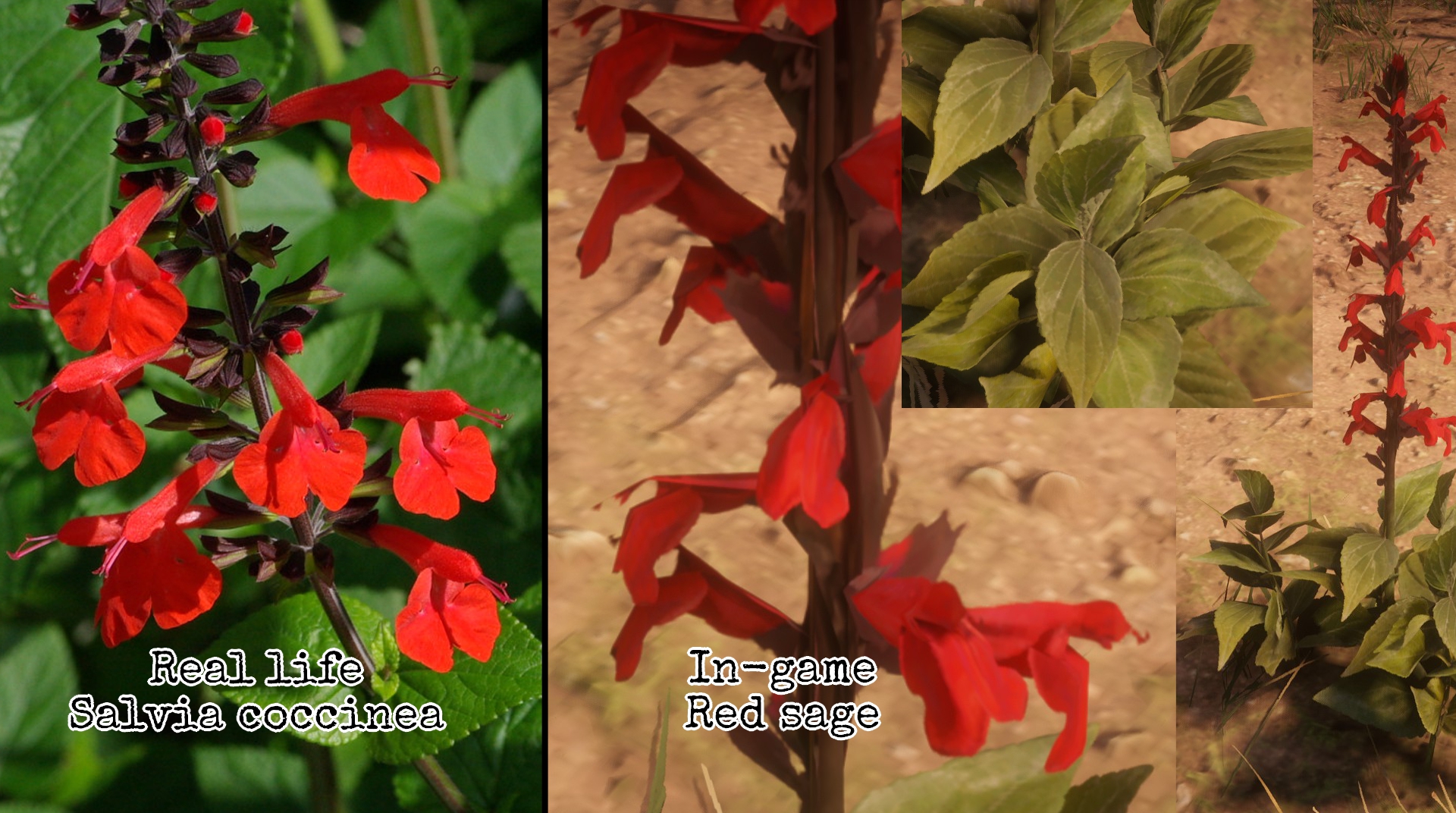
Salvia cocccinea
“Red sage” or “Desert sage”
When doing research for these plants I end up poking so many holes into the red dead wiki. This plant ingame is actually one of the more beautifully rendered! Its leaves have toothed margins and a simple shape with moderate venation which are true to life, and its flower spikes even more so! The flower definition is shown off spectacularly here, as you can see by the side-by-side comparison. Prominent stigma poking out of the top of the corolla, a more exaggerated bottom “petal” that acts as a landing pad for pollinators, a calyx that has a short, dark-colored petiole with a few protruding bracts along the dark red stem.
The rendering, the correct biome placement... This one’s a winner for sure. It’s just a shame you can’t see it earlier in the game.
My rating: 8/8. Red dead wiki fix your species IDs
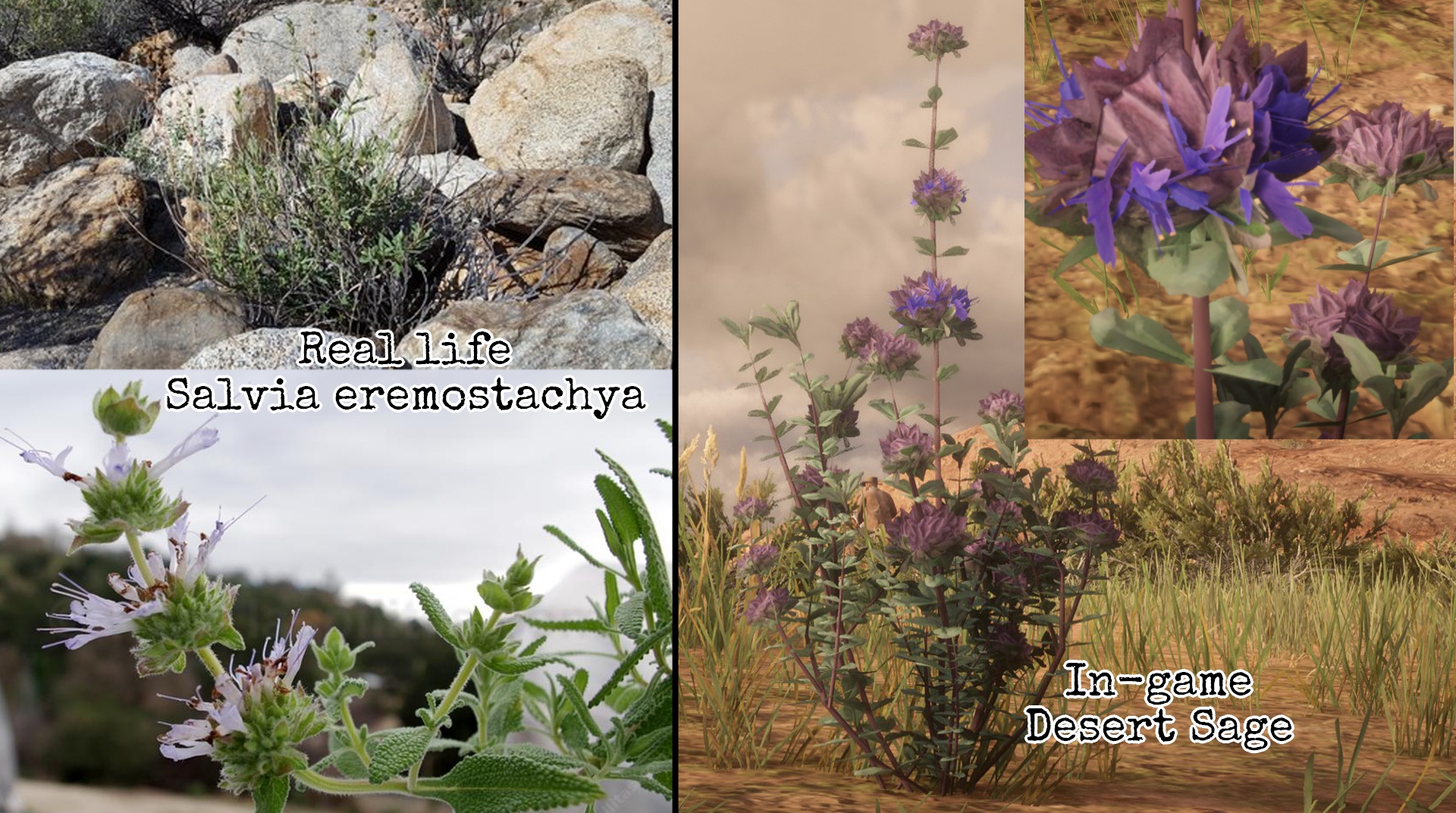
Salvia eremostachya
“Desert sage”
I am far from a Salvia expert (huge ass genus) so I only have a cursory knowledge of this plant, despite my relative proximity to its native range in the Colorado Desert and south to Baja California. It can be found in the game’s equivalent to this environment around Gaptooth Ridge in New Austin. The rendering on the flowers is gorgeous, with those characteristic protruding stamens and anthers, purple blooms nestled into bunching fuzzy bracts whorled intermittently on the stem. In researching this plant I came across a few cultivars that matched the ingame flower a little better, color and structure-wise, but I decided to stick with the OG wild species because fuck Burpee. Anyway. The leaves of this plant ingame are a little less defined than I would like, and their shape is changed from their irl toothy-margined lanceolate shape to a more rounded lobed shape. The growth structure is fantastic though; one base, no awkward bits sticking up from the ground with no rhyme or reason, and great care taken to render alternately spaced leaves on a dark woody stem.
My rating: 7/8
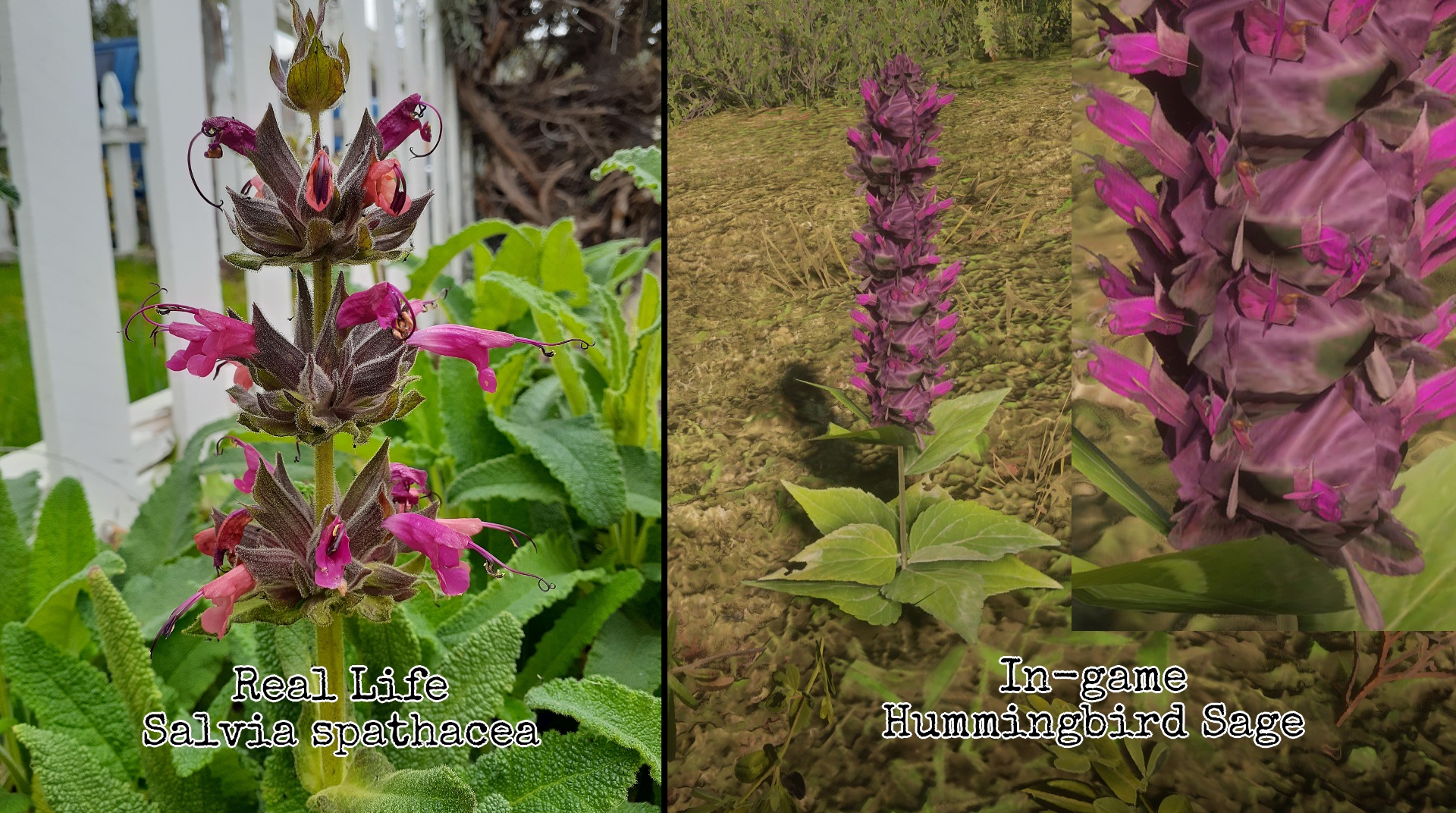
Salvia spathacea
“Hummingbird sage”
YEAH BABEY MY FAVORITE SALVIA! Salvia spathacea is a California endemic usually found around the coast and Sierra Nevada foothills in woodlands and open fields. Its leaves are lanceolate, usually growing from a basal rosette with a short petiole. They’re loved for their delightfully citrus smelling glands that cover the entire plant. The inflorescence is usually a tall singular stalk (sometimes branching from the base) with glabrous bracts arranged intermittently along the stem, from which pink flowers emerge and bloom sequentially from the bottom up, attractive to bees and especially hummingbirds.
In game, shortcuts were taken in rendering the characteristic clumped bracts, and the intermittent arrangement on the stem seems to have been compacted into one thick inflorescence. Even so, some care was taken to render the pink flowers and their protruding stamens and styles, so kudos there. The leaves were also inexplicably changed into a simple veined shape, with no evidence of the thick, hairy, and glabrous structure their real life counterparts have. Their in-game habitat also raises an eyebrow for me; you can find them all over the rdr2 map, where if they were going for something more realistic, I’d relegate them to only the tall trees/strawberry parts of West Elizabeth. I suppose the map needed a sage to be readily available to the player so they just chose this one to be widely distributed. Curse the intersection of video game functionality and real life logic. This is one of those plants in game that seems perfect at first glance but sort of falls apart when you look closer.
My rating: 5/8
Oplopanax horridus
“Alaskan ginseng”
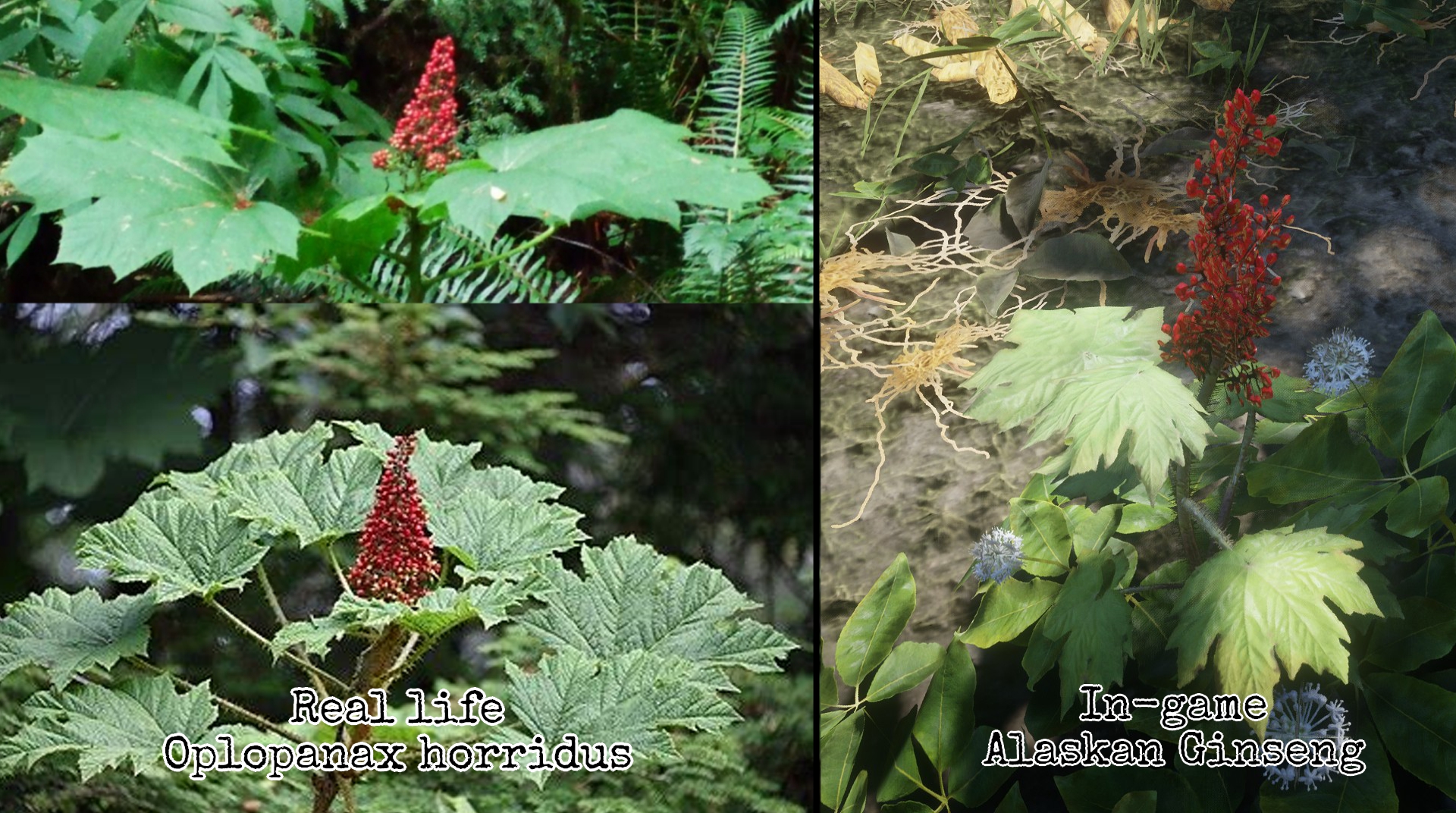
It’s kind of funny that the rdr2 team put Oplopanax horridus into the game as a consumable, considering that all parts of the raw plant are an irritant. If your Arthur isn’t wearing gloves when picking these, you’re giving the poor man a rash LOL. In all seriousness, Oplopanax horridus is a fascinating plant that can only be found in old growth and west coast forests. Its leaves are simple, palmately lobed, with a toothy margin. The plant has irritating hairs all along the stem, stalk, and undersides of the leaves. Its inflorescence is a white umbel, from which its characteristic bright red berries form. Although the berries, leaves, and roots are inedible while unprocessed, they’ve been used for thousands of years as a treatment for arthritis by the Ditidaht nation of modern day British Columbia, amongst others.
In game, these plants can be found sparsely across the map, but their distribution is sometimes far from their preferred habitats of rainy old growth forest. If it were really true to life, they’d be found only around the Big Trees area of West Elizabeth. Morphologically though, the game got these plants down to a T. Leaf shape and growth structure very similar to its irl counterpart, flowers AND fruits accurate; hell, the devs even took the time to render the hairs on the stems! It’s fantastic. My only complaint is that the leaves are a little too small; they can grow up to 15” across, far from the measly ~4” in game.
Another interesting fact I came across when researching this plant was
this paper which took an extract of Oplopanax horridus and used it in a test setting to kill Tuberculosis causing bacteria. (Someone quick, feed Arthur 99x Alaskan Ginseng right after the Downes mission! We can fix him!!)
My rating: 7/8
Panax quinquefolius
“American ginseng”
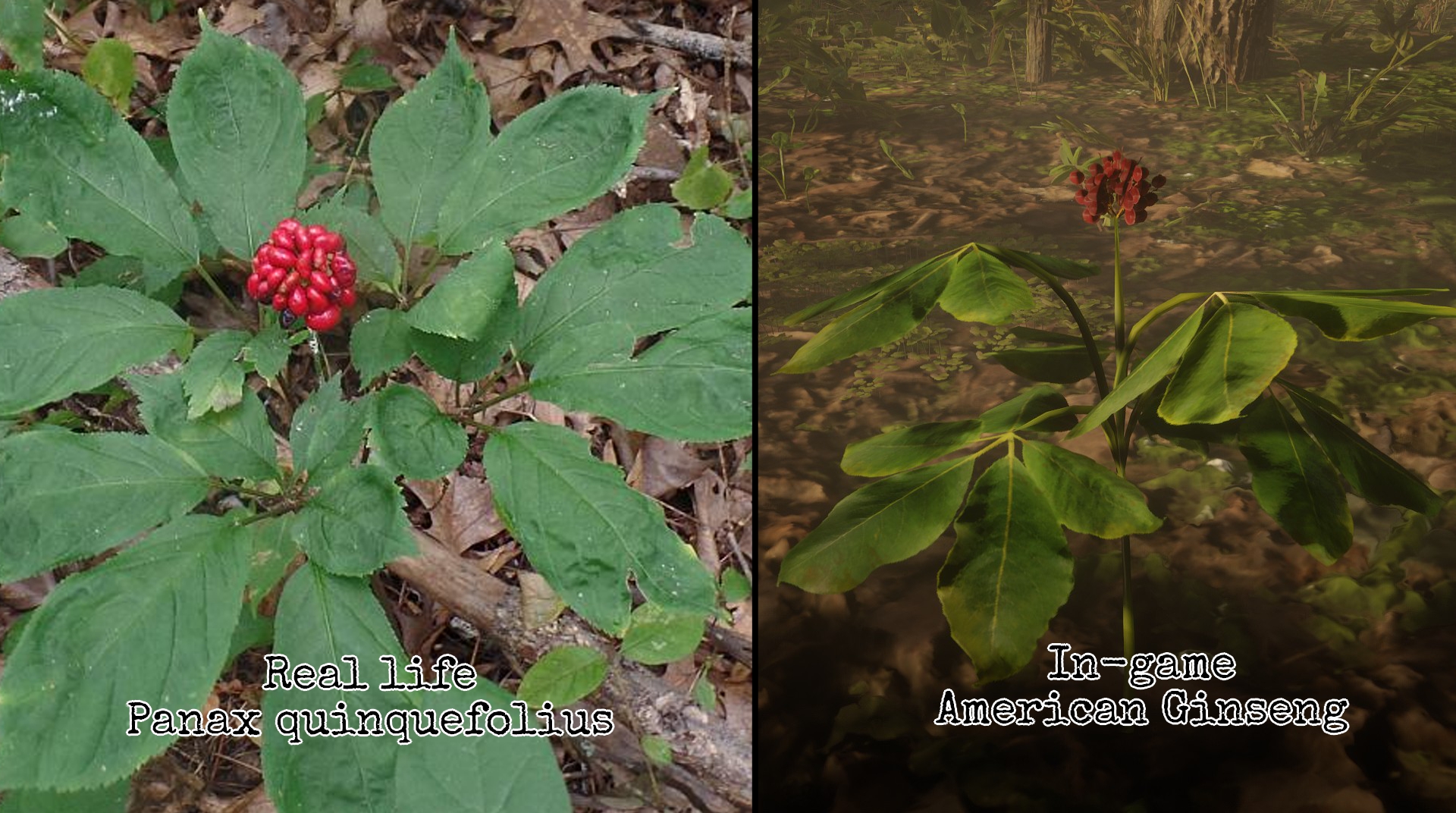
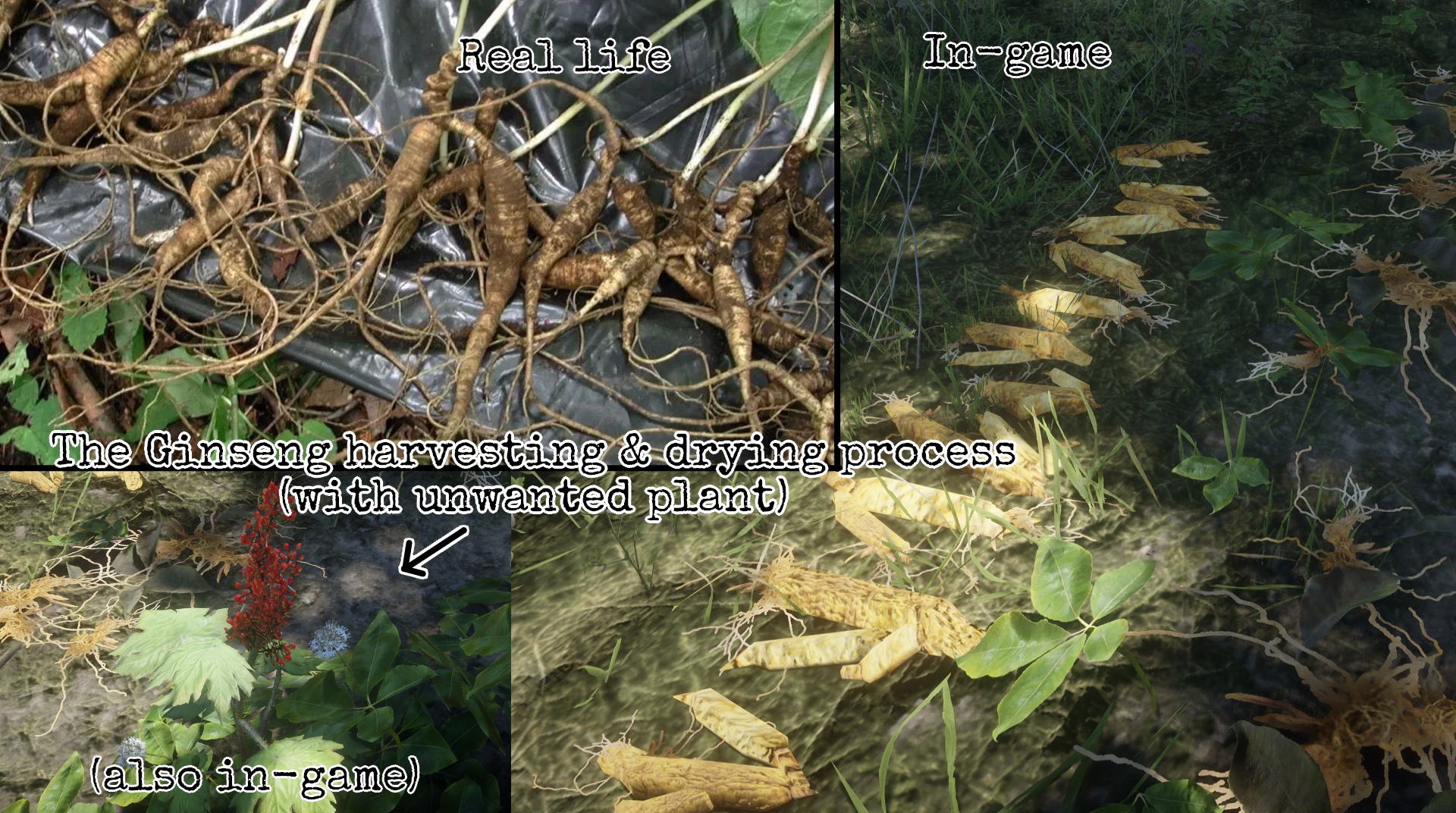
Panax quinquefolius is a really cool medicinal plant with a long history of harvest on the eastern North American continent. Morphologically, the ingame plant is beautifully accurate. Clusters of red berries emerging from a central stem, four stalks with palmately arranged, simple-shaped leaflets, and relatively small growth habit. It grows relatively slowly; growing one branch per year, and only flowering and fruiting when it’s grown its fourth branch at four years. This plant grows all over the eastern US and Canada and is highly sought after for its roots, which contain anti-inflammatory alkaloids and other compounds that have been used by native populations and settlers alike. Because of these properties, a massive industry was founded in the 1700s exporting poached plants to countries all over the world, which continues largely unregulated to this day. A few states have strict conservation laws to protect Panax quinquefolius’ sparse wild populations, but these laws are difficult to enforce. An area in-game that accurately reflects the process of growing and harvesting these plants by settlers is Chez Porter, in which you can see several plants in active growth, bloom, and drying after harvest. Funnily enough, despite the rows of intentionally grown Panax quinquefolius, the only harvestable “Ginseng” at the location is Oplopanax horridus, it’s skin-irritating cousin that I discussed previously. I’ve illustrated the difference in the image below.
My rating: 8/8
Arctium lappa
“Burdock root”
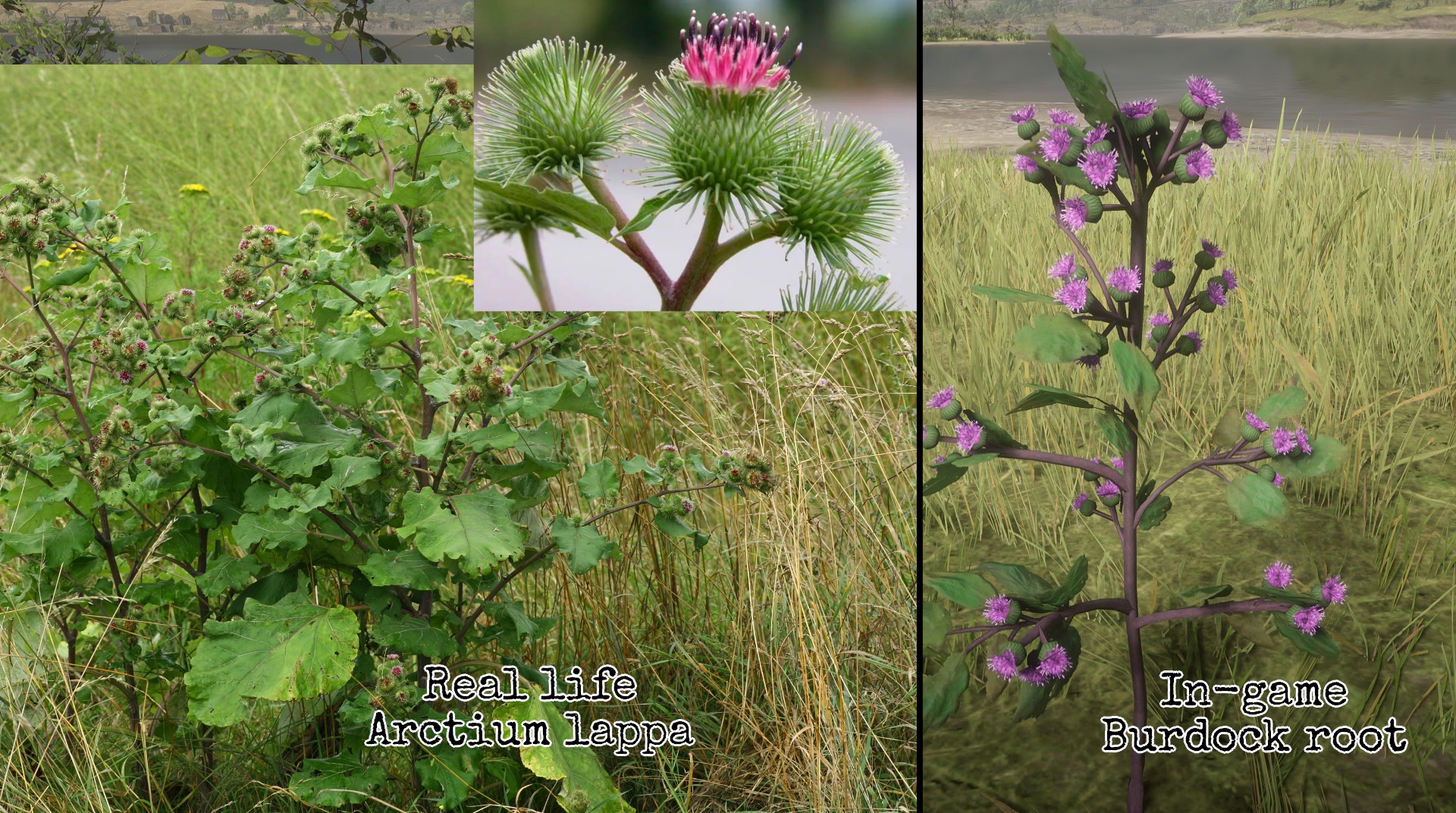
Arctium lappa is a plant I have a great fondness for since I’ve started foraging; it’s originally native to Eurasia and considered invasive in North America and Australia. I love it because its roots make for excellent use in stir fry. Morphologically, the ingame plant bears a good resemblance to its real life counterpart, but has some flaws; its growth habit irl is quite tall if given enough time to mature; I’ve cut a few that were over 6 feet tall around the coast of California. Its leaves are lacking their characteristic “waviness” around the margins, but the simple shape is represented accurately, as are the flowers and their bulbous bracts. I really wish they’d rendered the spikes on the bracts though, it would instantly shoot these up to an 8/8. These are another “naturalized” species that I can’t find any info on its time of arrival in the new world, so it’s dubious whether or not Arthur would’ve been able to find these as bountifully at this point in history. As it stands, though:
My rating: 4/8
Ribes nigrum
“Black currant”
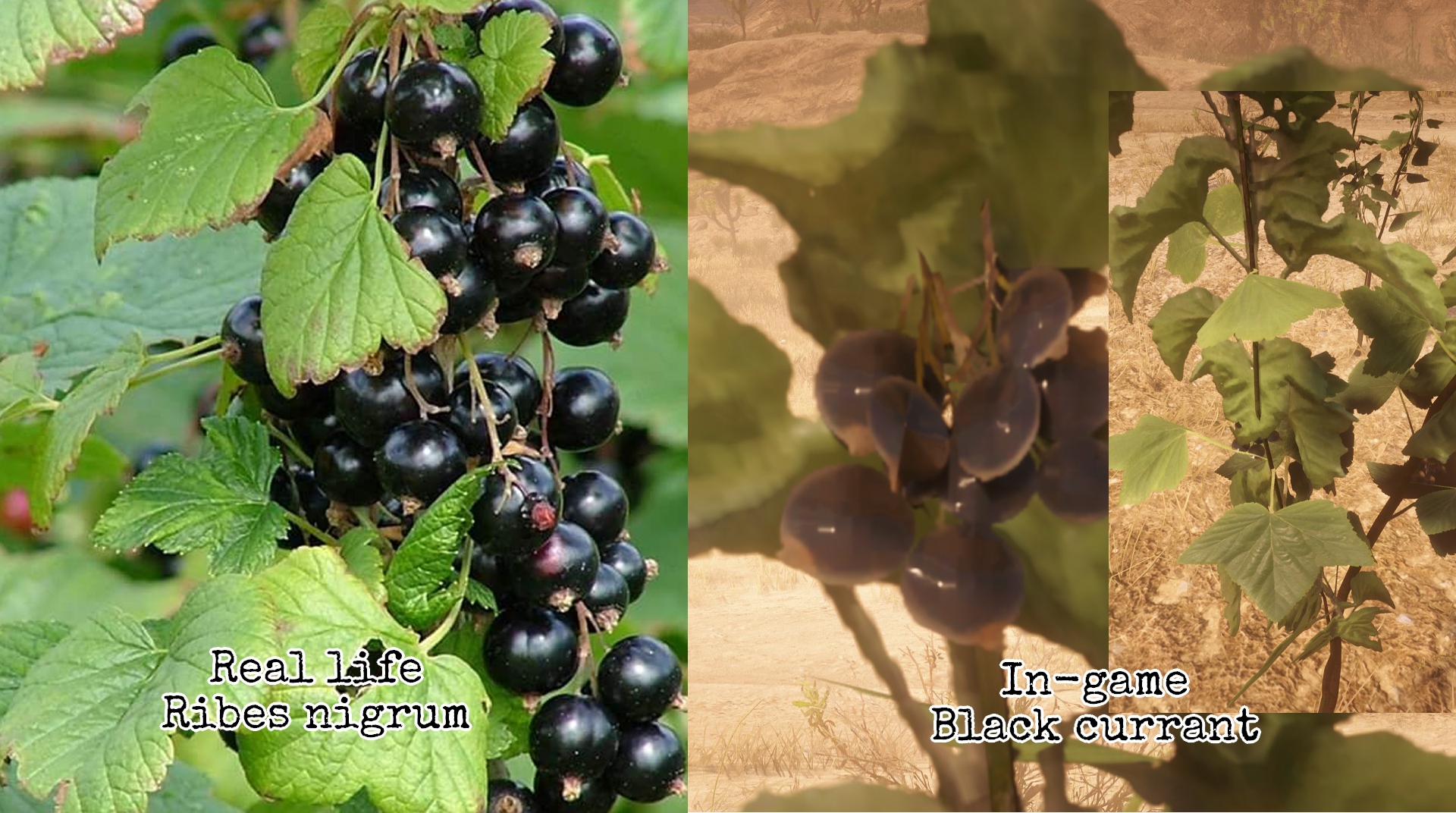
Ribes nigrum is a Eurasian native species grown for a number of commercial uses, including juice, fruit flavoring, preserves, and jam. Its history as an introduced species in the US began with the first settlers on the east coast and continued until the early 1900s, when it was outlawed for carrying white pine timber rust, a fungus which infected white pine and threatened the US settlers’ lumber industry. But that’s neither here nor there; it’s entirely likely that Arthur would’ve been able to find this plant growing feral at this time in the country, but interestingly, you can only find blackcurrant late in the game in New Austin; locations where R. nigrum would have an extremely difficult time growing due to heat and drought. It seems to me Rockstar developers might’ve switched the locations of the game’s two currants by mistake? Blackcurrant should be in New Hanover and Roanoke Ridge, switching places with Golden currant which should be growing in the west. As for its growth habit and morphology, the game’s rendering of Ribes nigrum is pretty accurate. An upright shrub with simple, lobed leaves and serrated edges, as well as nearly cauline fruits (growing close to the stem). The ingame plant lacks some definition, but its true-to-life stature and morphology easily make up for it.
My rating: 6/8
Ribes aureum
“Golden currant”
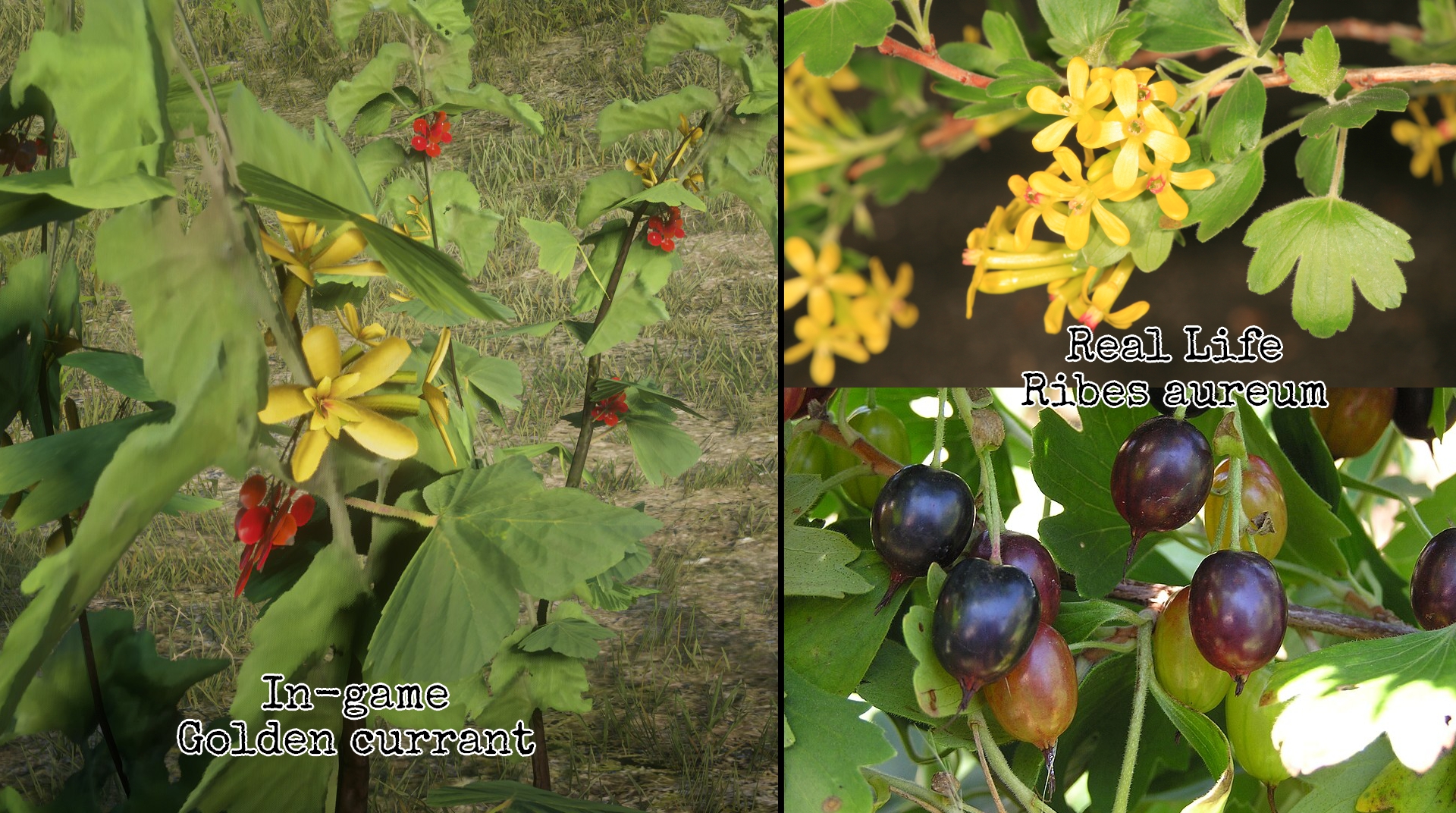
Ribes aureum is the more-bitter sibling to Ribes nigrum, with this species bearing the distinction that its flowers are also edible and (supposedly) quite delicious. It’s native west of the Mississippi, where it was used medicinally by many native nations pre and post-contact.
Morphologically, the ingame plant is a recolor of the Black Currant with Ribes aureum’s distinctive five-petaled flowers added for visual distinction. The game’s berries are strikingly red, however, which aren’t quite true-to-life, so I’m docking a point there. There’s a variety of R. aureum that’s been bred for showy berries, but its introduction was in the last forty years by a California breeder, so its inclusion in this game is anachronistic. Like I said earlier in the Ribes nigrum review, its location in the game doesn’t make much sense; R. aureum is a drought tolerant, sun-loving western native that belongs in the West Elizabeth/New Austin parts of the map, rather than the Roanoke Ridge area where it can be found. (Sidenote: as soon as my local nursery gets these in stock, I’m snagging one for my native plant garden 😊)
My rating: 6/8
Typha latifolia
“Common bulrush”
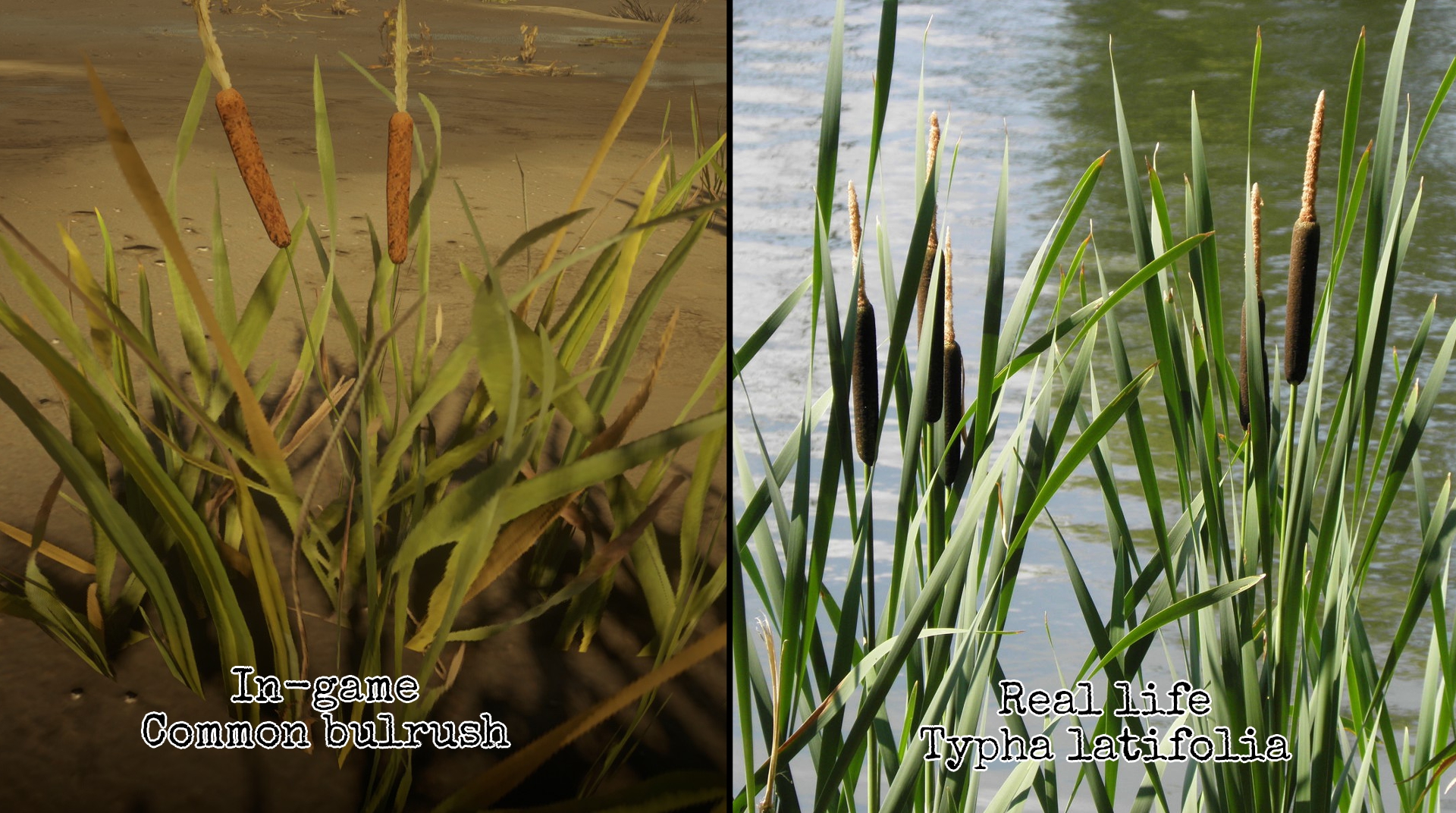
Typha latifolia is one that everyone in North America and Europe should be familiar with; it’s native to riparian areas all over the northern hemisphere and has been used as food and weaving material for millennia. Its stems, roots, and young flower buds are all edible (peeled and cooked) and nutritious. In modern days, you really have to tread carefully with eating them because so many freshwater deposits are polluted by runoff or other human activity. These plants actually act like a sponge with pollutants, making them invaluable in filtering freshwater and restoring wetland habitats, and potentially dangerous to eat.
In terms of the game’s depiction of Typha latifolia, there’s really not much to screw up. It can only be found near water, just like real life, it’s got long leaf blades, and dense flower stalks with the pistillate female flowers below the staminate male ones. That’s really all there is to it. Easy peasey cattail squeezey.
My rating: 8/8
Achillea ageratum
“English mace”
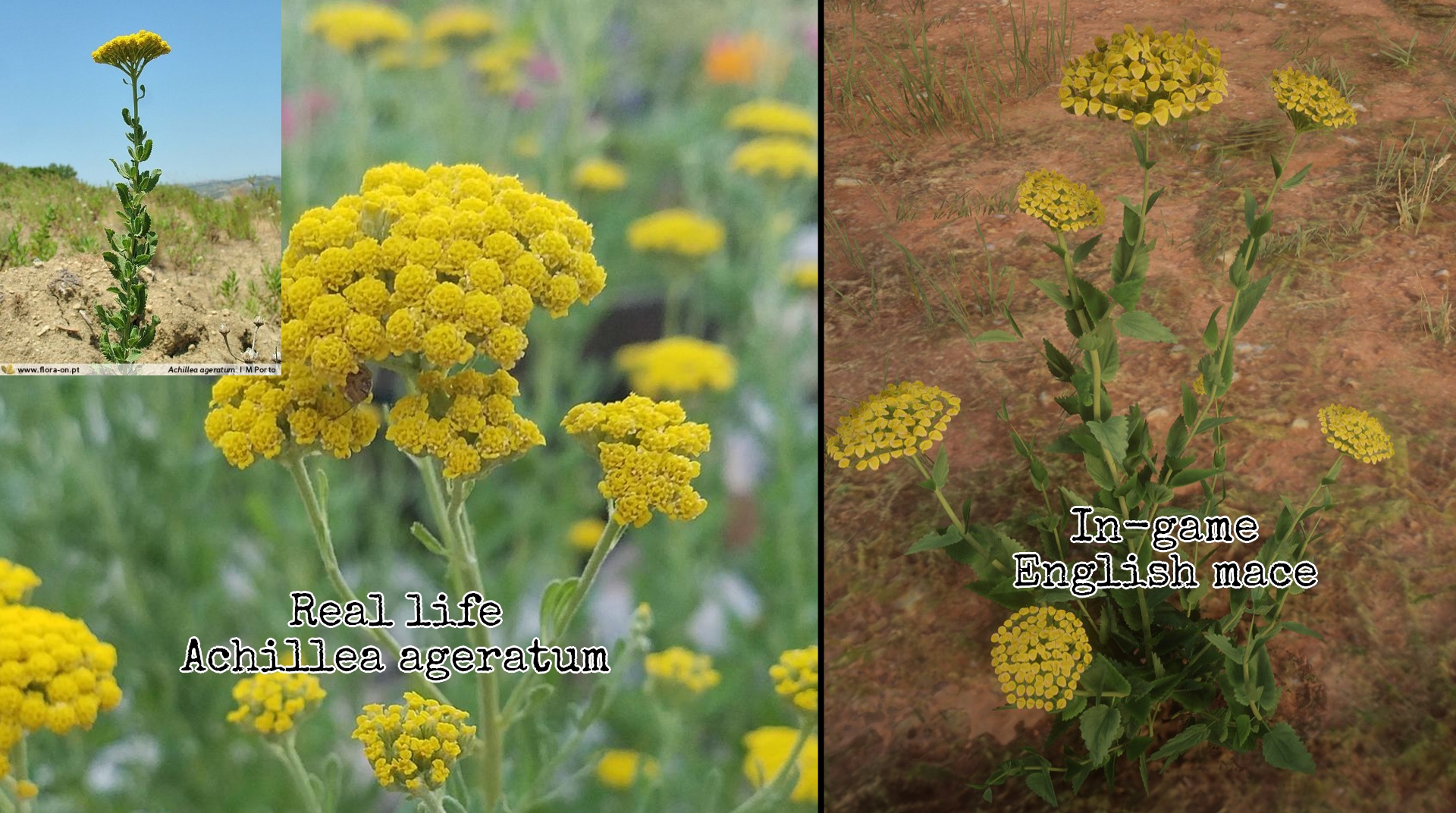
Achillea agerantum is a plant long cultivated in its native eurasian range for its lovely fragrance and mosquito/insect repellant qualities. It’s supposedly also got anti-inflammatory qualities, but from what I’ve read it’s mostly used for its flavor. Given that this is an introduced species in the US, it’s a little dubious whether or not Arthur/John would be able to find it growing wild throughout West Elizabeth and New Austin, but I do appreciate that it’s relegated to the drier mediterranean/desert climates it enjoys in real life. Morphologically, this plant’s near perfect; it’s got ill-defined little umbels of yellow florets with cauline leaves stemming from a central taproot. Its leaf edges are accurately serrate, and its overall growth structure is a perfect match to its real life counterpart. Genuinely no complaints here.
My rating: 8/8
Achillea millefolium
“Yarrow”
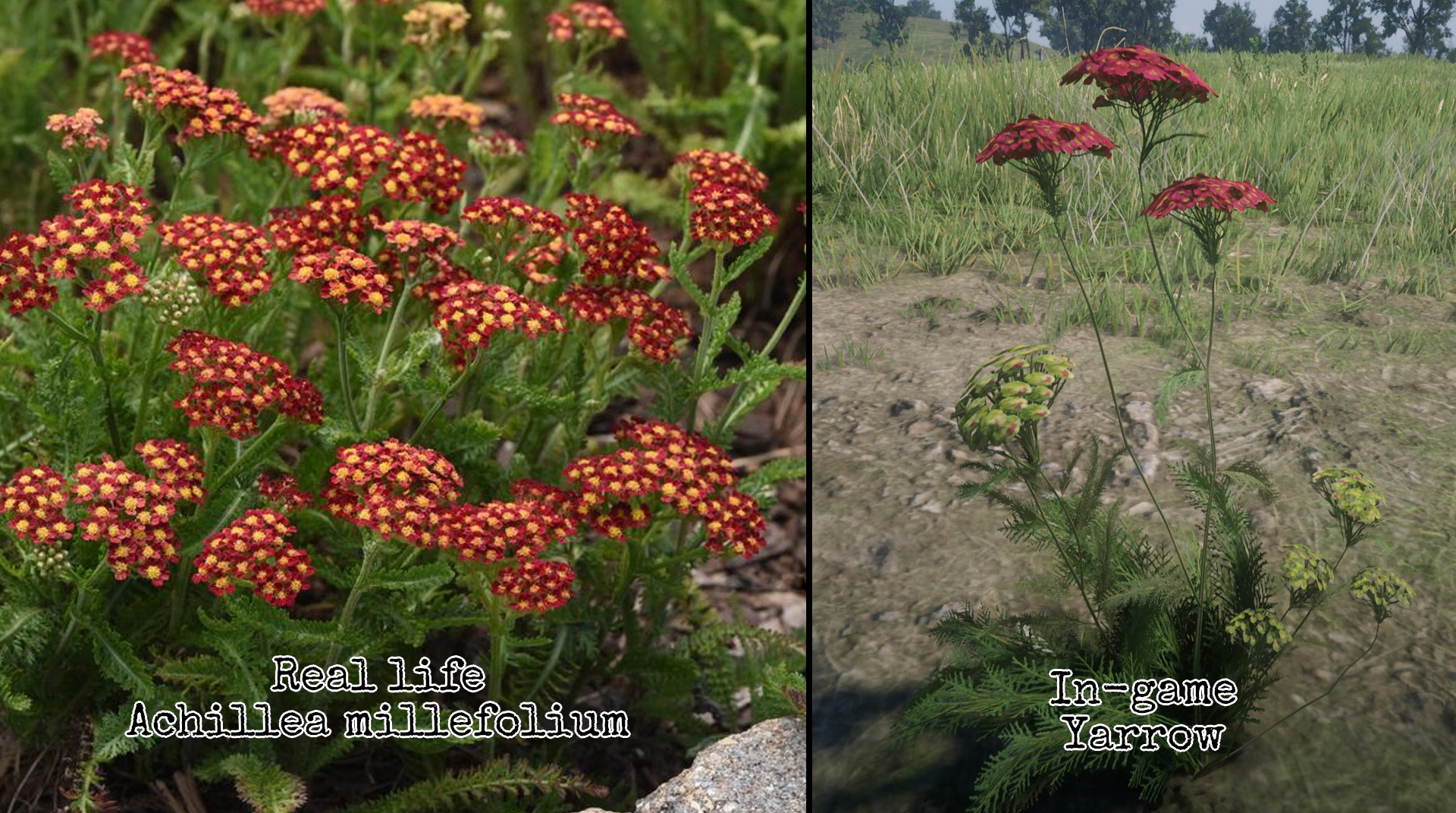
Achillea millefolium is a plant naturalized pretty much everywhere in the northern hemisphere, with specific subspecies and ecotypes in almost every biome you can think of. Given this, most native species of yarrow (ie, non-cultivated) are white. Why on earth are the game’s flowers red? Really. It’s a mystery that will haunt me to my grave. Besides that, this one’s another banger by the dev team! The plant looks stunning, with its umbels of densely clustered florets, its small cauline leaves, and large basal leaves bearing its namesake feathery, fernlike appearance. It’s also widely distributed ingame just like real life, and also harvestable for its health benefits. Yarrow irl has a wide variety of volatile oils, anti-inflammatory compounds, and natural acids good for digestion and infection. Its also been used historically to staunch bleeding.
My rating: 7/8
Crocus vernus
“Violet snowdrop”
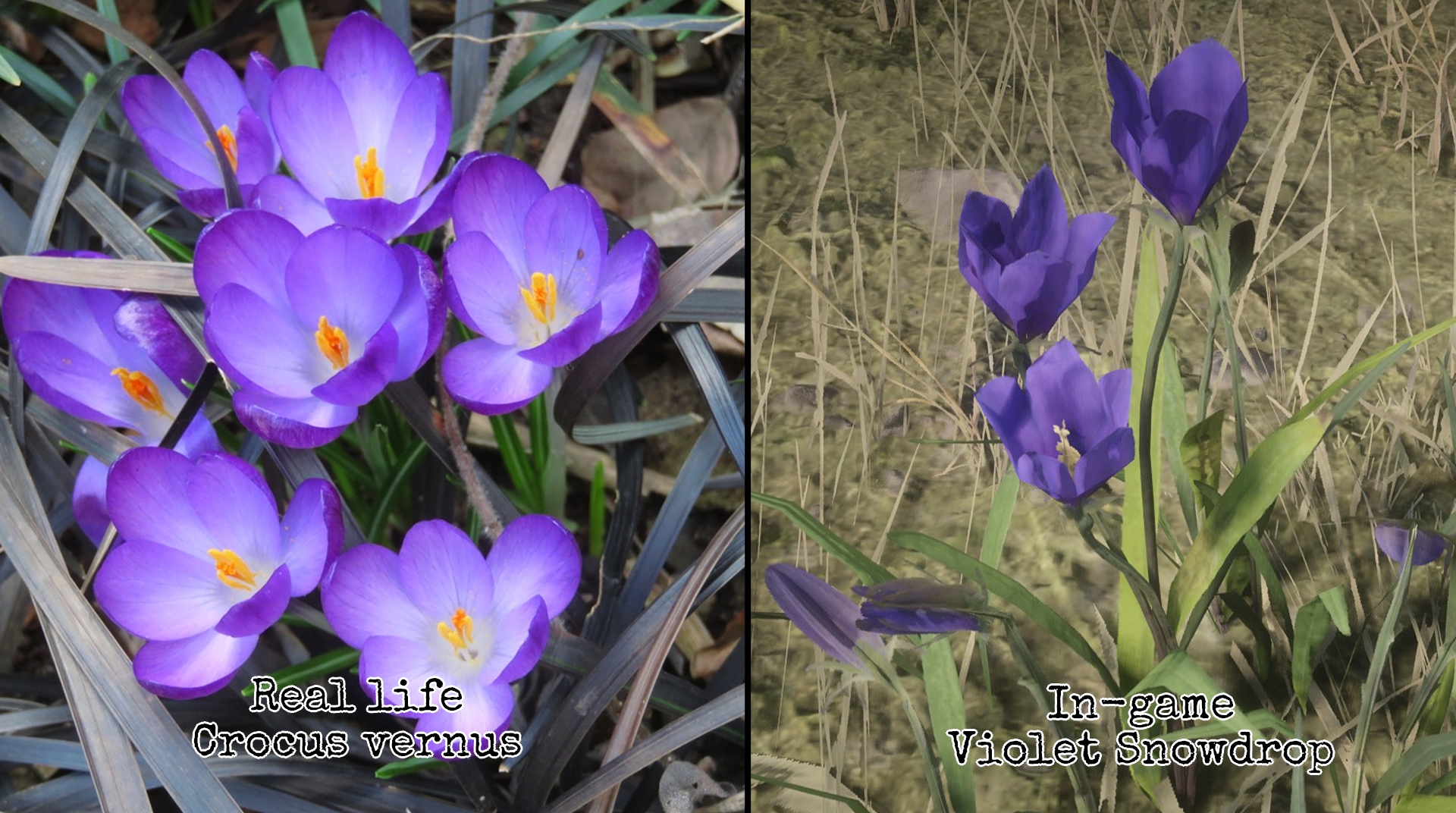
I’m not really sure why this plant ingame is called Violet Snowdrop? Maybe that’s an older common name no longer in use? The “Snowdrop” moniker is usually used in reference to the Galanthus genus, and I couldn’t find ant text relating it to Crocus. Either way, this is one of my favorite plants in the game to pick. Crocus vernus is a popular garden plant whose native range is around the Mediterranean basin. Its introduction to the new world is estimated to be around the 1850s, so it’s not entirely impossible for Arthur to have encountered this plant. Its ingame locations are near settlements, so it’s possible that feral populations are descended from defunct gardens. Morphologically, the game’s plant is pretty decent. Small, purple, cup-shaped inflorescences, stamens arranged compactly along the pistil, branched style, narrow blade-like leaves sprouting from an underground corm. My only gripe with the rendering is that there’s no variation in throat color or venation in the petals, which honestly look a little like tulips for their lack of detail. The growth habit is also a little taller than it would be in real life. Despite its flaws, I reall enjoy this plant.
My rating: 5/8
Nerium oleander
“Oleander sage”
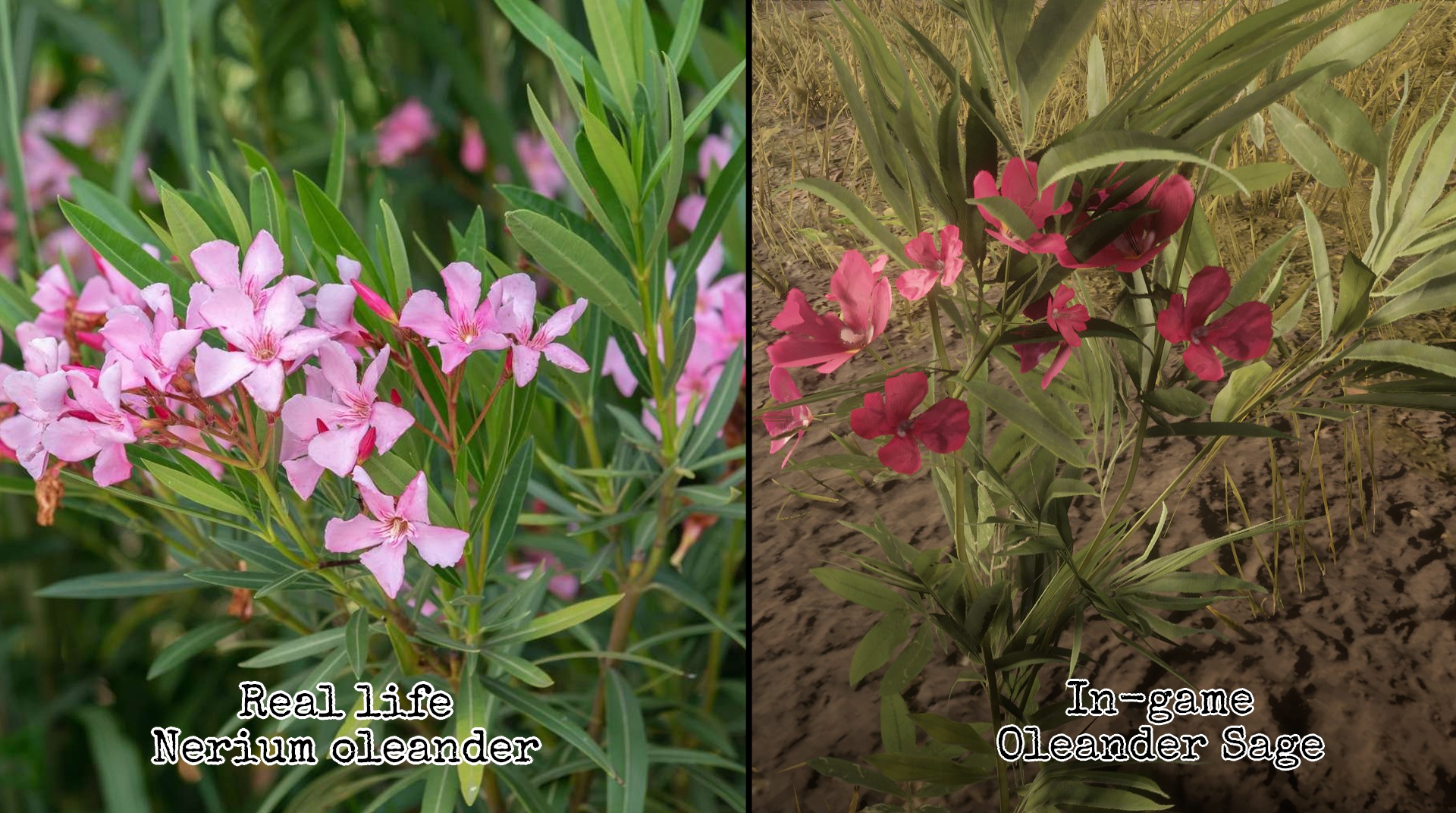
Nerium oleander is one of the most widespread naturalized plants in the modern world, with countless varieties and a family history so tangled it’s impossible to trace the true origin of the plant. If you live somewhere sunny, you know oleander. That being said, N. oleander’s introduction to the new world was actually somewhat recent; purportedly introduced first to Texas in the 1840s, but almost certainly thriving in other places in the new world before then. Finding it in the swamps of Lemoyne is hardly a surprise. Ingame, you can find it easily by its dark, leathery, lanceolate leaves and bright pink flowers. Bearing five petals and protruding anther filaments, its ingame rendering is as close to life as it’s possible to get; the only exception being the petals sometimes rendering with 4 instead of 5. Not sure if that’s a photo reference error or just the game rendering being slightly out of whack, but I’m not worried.
My rating: 8/8
Gaylussacia baccata
“Evergreen huckleberry”
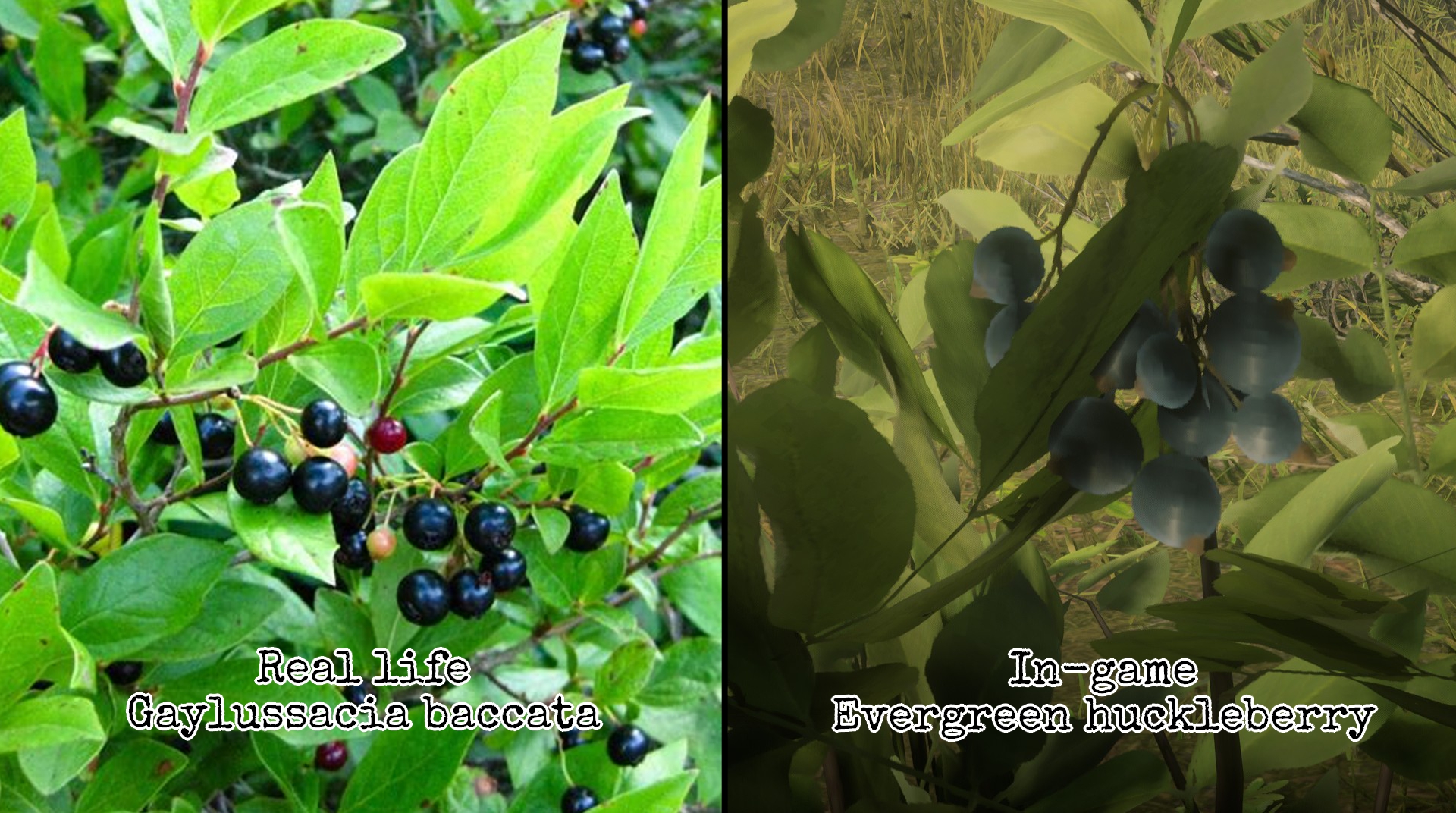
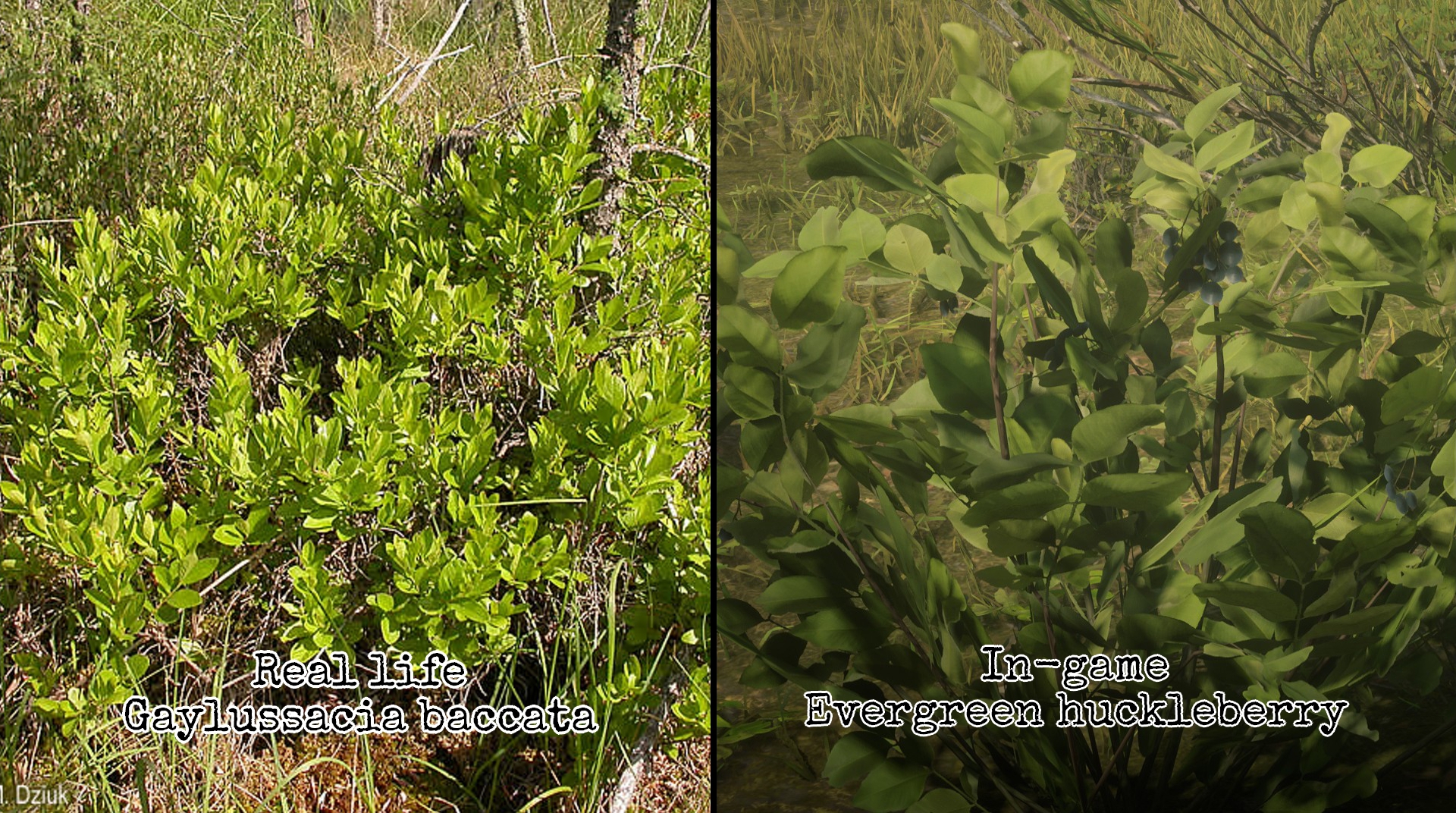
This is a nitpick I’ve been talking about since 2020. WHY in the world is this plant named “Evergreen huckleberry” when that moniker is used in reference to Vaccinium ovatum? V. ovatum is a west coast Cascade mountains native and it’s nowhere near the lowland Mississippi delta biome that Lemoyne stands in for?? If the developers wanted to avoid confusion they should’ve just named it “Huckleberry”. Gaylussacia baccata is also clearly the plant they modeled the ingame one after, too, with its simple leaves, low-to-medium shrub habit, and berries growing off a short stem rather the nearly cauline berries of V. ovatum. Granted, they’re in the same family, but still. The “Evergreen” common name has sadly made the Red Dead Wiki misidentify another species. I’ve attached two photos for double the evidence, lol.
Anyway, stupid common names aside: yeah this plant is pretty accurate. It can be found all over Lemoyne just like Gaylussacia baccata can be found all over the south, and its inclusion in the game is very welcome to make Lemoyne FEEL like the south. (oh how I wish they’d included Callicarpa americana!)
My rating: 7/8 For the annoying common name mixup. This is why we use scientific names for plants
Thymus serpyllum
“Creeping thyme”
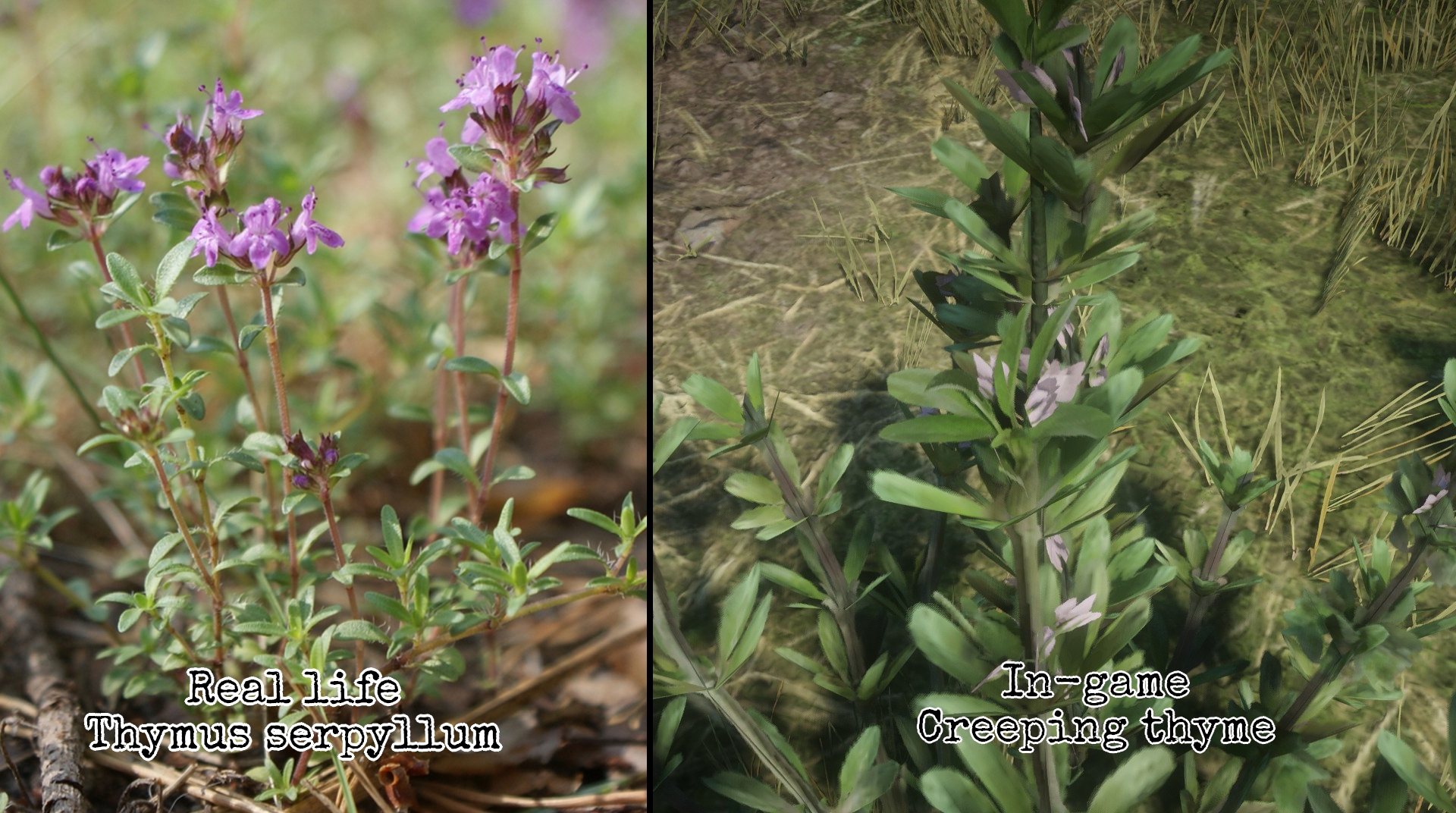
Thymus serpyllum is a low growing woody shrub that you’ll be familiar with if you cook at all. It’s got simple leaves and is highly aromatic, giving a complex, almost peppery warm flavor to anything it’s cooked with. Some varieties also are grown for a lemon-like flavor profile. It’s another old world Mediterranean native, just as happy to grow in hot dry places as it is cold wet ones. Unlike its ingame counterpart though, Thymus serpyllum doesn’t grow much taller than ~6”. Otherwise, the game devs really got this one down to a T with its oval leaves, little Lamiaceae typical flowers, and creeping growth habit. Sources I found discussing Thymus serpyllum’s introduction to North America place it around the late 1700s, which tracks with its use in popular French cuisine. As such, its placement all over the map in rdr2 is relatively accurate, and Arthur could’ve easily been munching on some pork chops seasoned with creeping thyme at this time in history.
My rating: 7/8
.jpg)